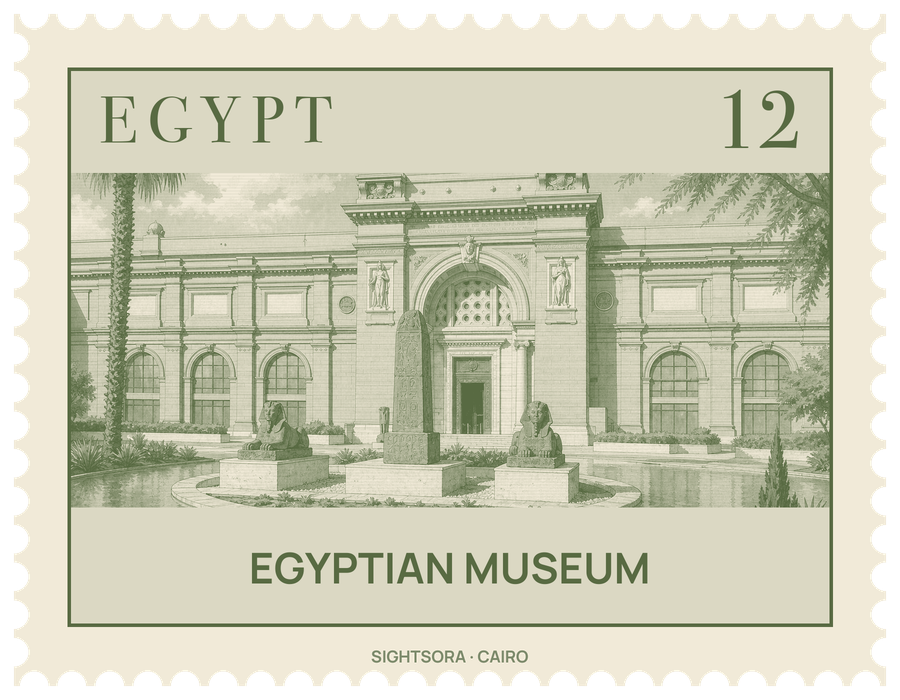
Work started with a foundation ceremony on 1 April 1897, and the museum opened on 15 November 1902, after the collection had been hauled across from a palace in Giza by thousands of carts and by trains that made about nineteen round trips. It grew out of earlier museums at Boulaq and Giza founded by Auguste Mariette, who asked to be buried among his finds; his tomb lies in the museum garden.
The ground floor holds the heavy stone pieces, statues, reliefs and architectural fragments, arranged clockwise in time order from pre-dynastic times to the Greco-Roman period across 42 rooms. The first floor is given to smaller objects: papyri in Greek, Latin, Arabic and ancient Egyptian, coins of gold, silver and bronze that are Egyptian, Greek, Roman and Islamic, textiles and wooden coffins. Maspero, the museum's early director, compared its crowded halls to a pharaoh's tomb or temple, where every surface carried something to see.
Among the earliest pieces are the Narmer Palette and a statue of Khasekhemwy from the first dynasties. The Old Kingdom is represented by statues of Djoser, Menkaure and Pepi I, the statue called Sheikh El-Balad, the dwarf Seneb with his wife, and the seated pair of Prince Rahotep and Nofret, along with a small ivory figure of Khufu. Later halls show a colossal statue of Amenhotep III and Tiye, the treasures of Middle Kingdom princesses, and the gold of Tanis, where the kings Psusennes I, Amenemope and Shoshenq II were buried with funerary masks of their own. The Dush Treasure, found in 1989, comes from the Roman period.
Several famous holdings have left the building. On 3 April 2021, twenty-two royal mummies of the New Kingdom, 18 kings and 4 queens, were carried through the city in the Pharaohs' Golden Parade to their new home in Fustat, the National Museum of Egyptian Civilization. The objects from Tutankhamun's tomb, including his gold mask and throne, have since been moved to the Grand Egyptian Museum in Giza, together with other pieces such as the dyad of Amun and Mut from Karnak.
In the garden beside the building, a monument to Mariette is ringed by 24 busts of Egyptologists, among them Champollion, Lepsius, Maspero, Selim Hassan and Kazimierz Michałowski. The building itself was registered as a heritage site in 1983 for its architecture.
Getting there
The museum stands on the northern side of Tahrir Square; Sadat Station, the closest metro stop, is on the square itself, and cars can use the multi-story Tahrir car park.