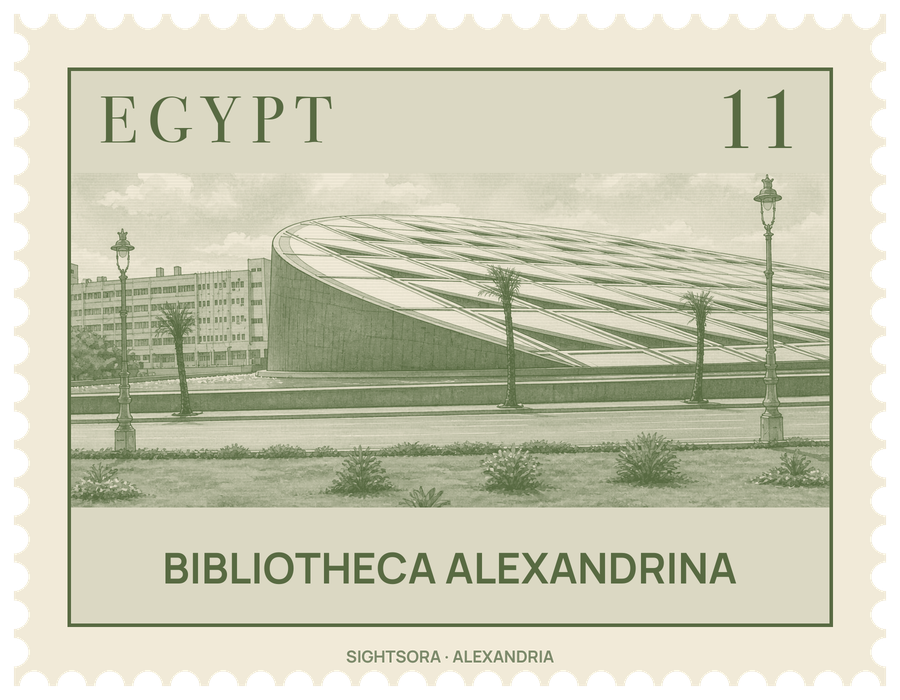
The idea goes back to 1974, when Alexandria University chose a plot between its campus and the sea, close to where the old library once stood. With UNESCO as a partner, a design competition in 1988 was won by Snøhetta, a Norwegian practice; building began in 1995, and the complex was inaugurated on 16 October 2002.
The building is shaped to suggest a rising sun. Its main reading room lies beneath a glass-panelled roof 32 metres high and some 160 m across, angled out towards the sea like a sundial, and steps down over eleven levels covering 20,000 square metres. Its grey granite walls are carved with characters from 120 scripts, designed by the Norwegian artist Jorunn Sannes. Its shelves can take eight million books in Arabic, English, French and other languages, and among its special sections are the Taha Hussein Library for blind and visually impaired readers and a collection of works by Nobel laureates in literature.
Several museums share the complex. The Antiquities Museum, opened in 2001, holds about 1,316 objects, including finds raised from the sea floor off Alexandria, in the Bay of Abukir and the Eastern Harbour, with labels in English, Arabic and French. The Manuscript Museum shows rare manuscripts and books, and a museum devoted to Anwar Sadat displays the Nobel Prize medal and the Qur'an that belonged to him, along with his military robes, handwritten letters and family photographs, and the blood-stained robe he wore on the day he was assassinated.
There are also a planetarium, four galleries for temporary exhibitions and 15 permanent exhibitions. Among these, Impressions of Alexandria presents the city through the eyes of artists and travellers and in old photographs of its cosmopolitan past, and another room is given over to the film director Shadi Abdel Salam. The Culturama hall wraps visitors in a 180-degree panoramic screen, 10 meters across, built from nine flat screens arranged in a semicircle.