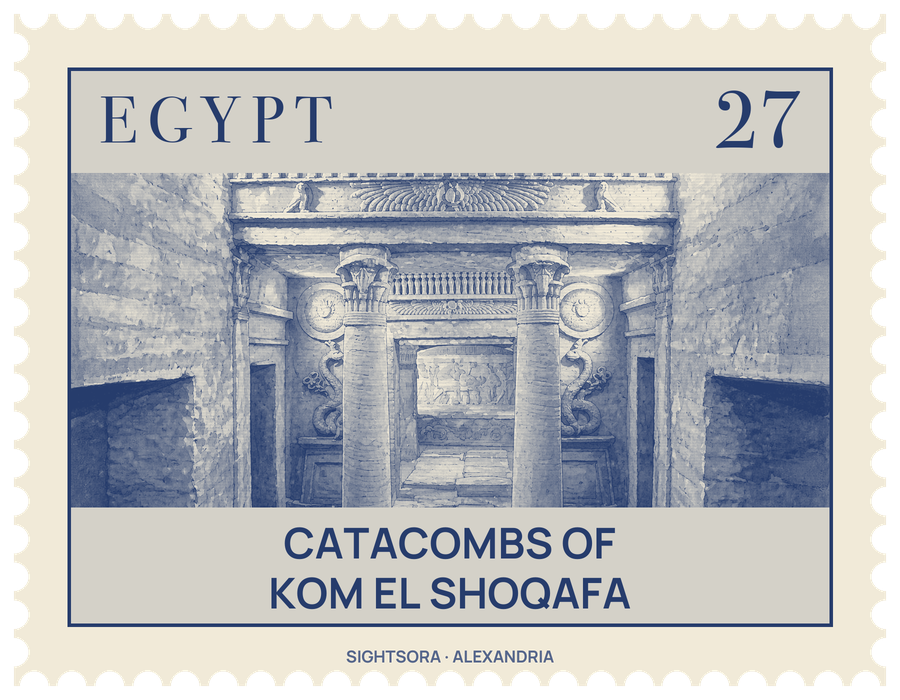
The catacombs were tunnelled out in the 2nd century, in the age of the Antonine emperors, and burials continued until the 4th century. They were forgotten until 1900, when a donkey fell into the access shaft. They are counted among the Seven Wonders of the Middle Ages.
The name means Mound of Shards. People who came to visit the dead brought food and wine in clay jars and dishes, and rather than carry them home from a place of death they smashed them, leaving heaps of broken pottery that were still there when the tombs were found. On the left of the vestibule, beside the six-pillared central shaft, is a triclinium, the funeral banquet hall where relatives gathered on stone couches at the burial and on later visits of remembrance. A gap broken through the rotunda wall at some unknown date leads to the Hall of Caracalla, where bones of horses and of people were found.
The principal tomb chamber is the high point. Its entrance is framed like a small temple: two columns with papyrus, lotus and acanthus capitals carry an architrave with a winged sun disk between Horus falcons, and on each side a serpent, the Agathodaemon, wears the double crown of Egypt and carries both a Roman caduceus and a Greek thyrsus, beneath a shield bearing the head of Medusa. Carved figures of a man and a woman stand stiffly in the Egyptian manner, but his head is modelled in the Greek way and she wears a Roman hairstyle.
Inside, three massive stone sarcophagi with fixed lids line the sides of the chamber, decorated with garlands and heads of Greek gods; the bodies were probably slid in from behind, through a passage that runs around the outside. Above them, relief panels show the jackal-headed Anubis in the dress of a Roman soldier mummifying a body on a lion-shaped bed, with three canopic jars below, and the Apis bull receiving a gift. Recesses in the surrounding walls each held three mummies, and although the tomb seems to have been meant for a single family, it was later enlarged for many more burials.