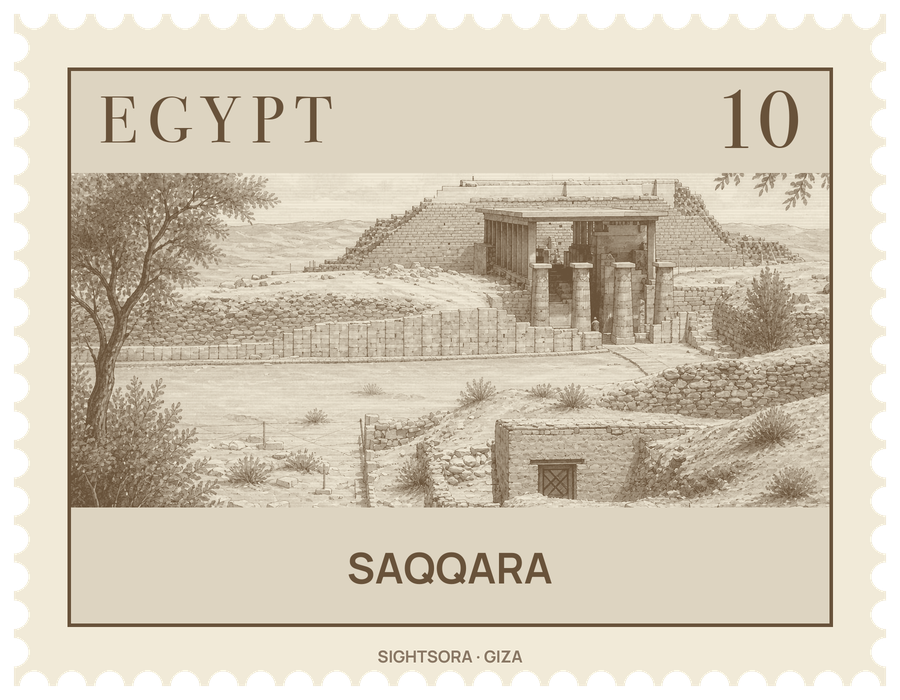
Kings, nobles and officials were buried here for more than 3,000 years, from the First Dynasty well into Ptolemaic and Roman times, so the plateau is covered with pyramids, mastaba tombs and underground galleries from almost every period. With Abusir to the north, Dahshur to the south and Giza farther north, it belongs to the Memphite Necropolis, a UNESCO World Heritage Site since 1979.
The landmark of the site is the Step Pyramid of Djoser, built in the Third Dynasty by the royal architect Imhotep. It stands within a funerary complex that includes a great enclosure wall, many dummy buildings and a second tomb known as the Southern Tomb, and a vast trench called the Dry Moat is cut around it, thought to model the dead king's road to the netherworld. The French architect Jean-Philippe Lauer spent most of his life digging and restoring the complex.
Sixteen more kings built pyramids at Saqqara, many of them in the Fifth and Sixth Dynasties, when the site again became the royal cemetery. These later pyramids have cores of rubble instead of solid blocks, so they survive less well than those at Giza. The pyramid of Unas, last king of the Fifth Dynasty, was the first to have its chambers inscribed with the Pyramid Texts; centuries later Prince Khaemweset, son of Ramesses II, restored it and recorded the work on its south face. Courtiers were buried in mastabas around their kings, so dense groups of private tombs surround the pyramids of Unas and Teti, among them the mastaba of Khnumhotep and Niankhkhnum.
In the New Kingdom, when Memphis was again a centre of government, high officials built tombs here, including Horemheb, who raised a large tomb at Saqqara while still a general although as pharaoh he was finally laid to rest in the Valley of the Kings, and Maia, the wet-nurse of Tutankhamun. Khaemweset also enlarged the Serapeum, the underground burial place of the sacred Apis bulls, where he himself was later laid to rest; Auguste Mariette rediscovered it in 1851, and most of it dates from the Ptolemaic Period. Later pilgrims came to cult centres around it, and long galleries were cut into the rock for mummified ibises, baboons, cats, dogs and falcons; at the dog catacomb next to the temple of Anubis, almost eight million animal mummies have been found.