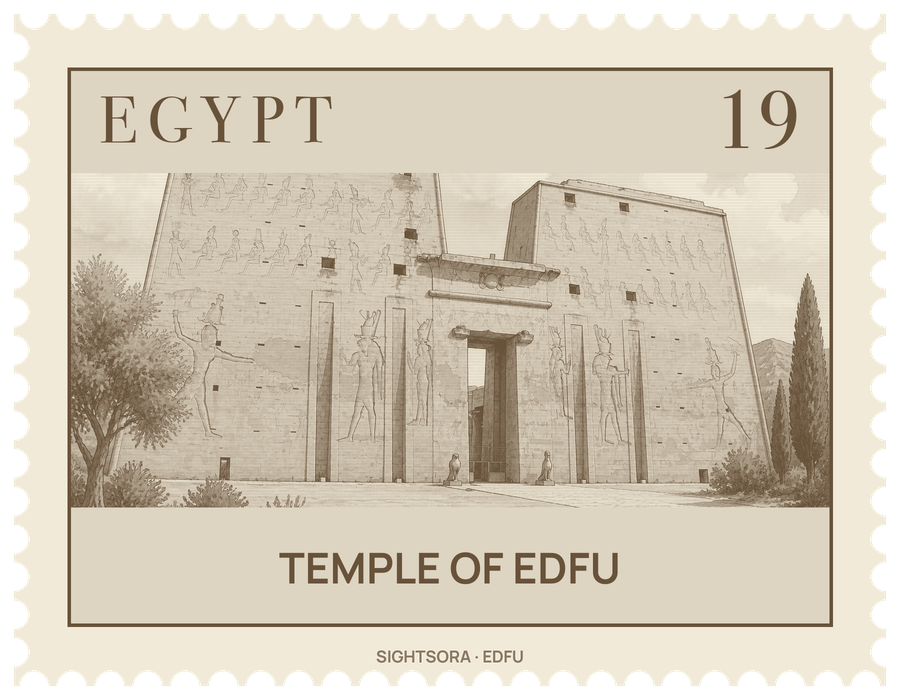
It was begun on 23 August 237 BC under Ptolemy III Euergetes and finished in 57 BC under Ptolemy XII Auletes, which makes it one of a group of temples raised in the Ptolemaic period alongside Dendera, Esna, Kom Ombo and Philae. The Greeks knew the town as Apollonopolis Magna, because they identified Horus with Apollo.
Part of its good condition comes from being forgotten. Over the centuries drifting sand and Nile silt buried the temple up to 12 metres deep, and people built their houses on top of it; by 1798, when a French expedition identified it, only the upper parts of the pylons showed. The French Egyptologist Auguste Mariette started clearing it in 1860. Its completeness has made it a regular stop for the riverboats that cruise the Nile.
The temple runs north to south, unlike the smaller earlier temple of Horus on the same spot, which faced east to west; a ruined pylon from older building work lies just east of the present one. Visitors pass through the pylon into a columned court, where a statue of Horus stands, then on through a pillared hall and two transverse halls towards the sanctuary. The inner sanctuary stands on its own and still holds a naos, a stone shrine, of Nectanebo II taken from an earlier building, while nine chapels surround the barque sanctuary.
The walls are what make Edfu so useful to scholars, since they are covered in inscriptions about the building of the temple, its myths and its rituals. Scenes on the inner face of the perimeter wall tell the temple's creation story: a world covered by water, reeds rising where land neared the surface, Horus landing there as a falcon, and the gods Thoth and Seshat drawing up the first temple, made of reed. Other scenes show the Sacred Drama of the old conflict between Horus and Seth, and there is a nilometer for measuring the height of the river.
Edfu was the focus of several festivals of Horus. Every year, the inscriptions relate, the goddess Hathor travelled south from her temple at Dendera to visit him here, and their sacred marriage was celebrated with a great festival and pilgrimage. Far from Egypt, the courtyard columns were closely copied on the front of the Temple Works in Holbeck, Leeds.