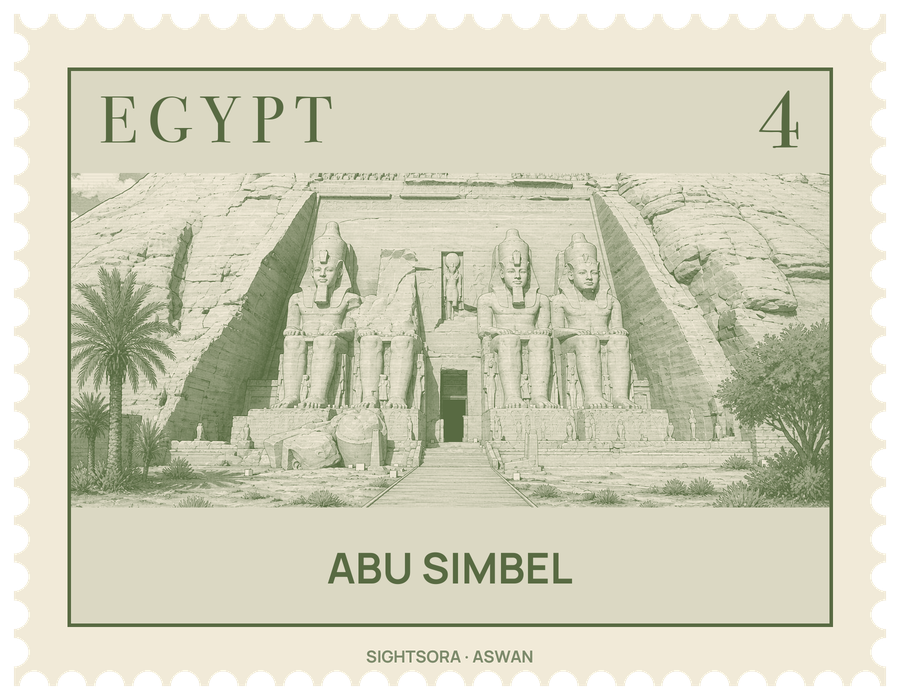
Ramesses II had them carved in the 13th century BC, starting around 1264 BC, in Nubia, a land the Egyptians prized for its gold and wanted to impress with their power. The larger temple honours the king himself together with the gods Amun, Ra-Horakhty and Ptah; the smaller one is devoted to the goddess Hathor and to Nefertari, his chief wife. With Philae and other rescued temples of the region, they belong to the Nubian Monuments World Heritage Site.
Four seated figures of Ramesses, each 20 m tall under the combined crown of Upper and Lower Egypt, guard the single doorway of the Great Temple. The one just left of the entrance lost its head and upper body in an earthquake, and the broken pieces lie at its feet where they were found. Smaller statues of Nefertari, the king's mother Mut-Tuy and several of his sons and daughters stand beside the legs, none reaching higher than the royal knees. Above them, a row of twenty-two baboons greets the rising sun, and in a niche over the door the falcon-headed Ra-Horakhty holds symbols that spell out the king's throne name, User-Maat-Re.
Inside, the rooms shrink as they go deeper into the rock. The first hall rests on eight pillars carved as the king in the form of Osiris, and its walls show Ramesses at war, above all at the Battle of Kadesh against the Hittites, where he fires arrows from his chariot at fleeing enemies. A second hall with four pillars leads to the sanctuary, where four seated figures are cut from the back wall: Ra-Horakhty, the deified Ramesses, Amun Ra and Ptah. On two mornings each year, around 22 February and 22 October, the rising sun reaches through the whole temple to light three of them, while Ptah, a god tied to the realm of the dead, stays in shadow, and people gather at the temple on those days to see it.
About 100 m to the northeast, the Small Temple has six standing colossi slightly over 10 m high on its front, the king and Nefertari shown at the same size, which was rare in Egyptian art. Its hall stands on pillars topped with the face of Hathor and carved with the queen playing the sistrum before the gods, and reliefs further in show the royal couple offering papyrus to Hathor as a cow in a boat among the reeds. In the sanctuary niche the goddess, again in cow form, seems to step out of the mountain.
Neither temple stands where it was carved. When the Aswan High Dam threatened to drown them, an international rescue led by UNESCO had the temples sawn into 1,036 blocks in 1965 and 1966 and rebuilt on higher ground, the Great Temple 65 m above its old level and 208 m further inland. Concrete domes now carry the weight of an artificial hill built over them from the original rock, and the new site was oriented so that the sun still enters the sanctuary twice a year. The relocation, inaugurated on 22 September 1968, helped bring about the convention that created the World Heritage List.
Getting there
Abu Simbel lies about 230 km southwest of Aswan, or about 300 km by road, and most visitors drive from Aswan, the nearest city. Abu Simbel Airport, 2 km from the town and built to serve the temples, connects the site by air with Aswan International Airport.