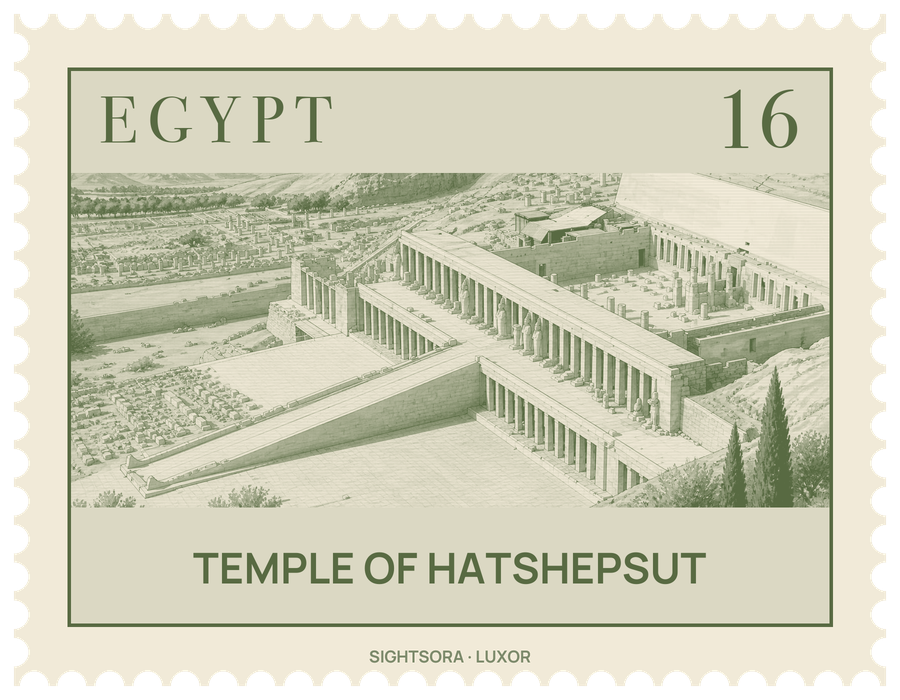
She called it Djeser-Djeseru, the Holy of Holies. It was raised between the seventh and twentieth years of her reign, its plans revised several times along the way, and it took its stepped design from the older temple of Mentuhotep II that stands immediately to the south. The architect is not known for certain; Senenmut, her Overseer of Works, and the High Priest Hapuseneb have both been suggested.
The temple was laid out to face Karnak on the other bank. Each year, in the Beautiful Festival of the Valley, the barque of Amun was carried in procession from Hatshepsut's Eighth Pylon at Karnak, across the river and up a causeway about 1 kilometre long from the valley temple, lined beyond its halfway point by more than 100 sandstone sphinxes, to rest overnight in the sanctuary here. Her own tomb in the Valley of the Kings was cut into the same massif, beneath the peak of El Qurn.
Ramps lead up the centre of the terraces. On the lower terrace, the remains of Persea trees mark where a garden once grew, and the reliefs of the south portico show two obelisks being shipped from Elephantine to Karnak. The middle terrace holds the temple's most celebrated reliefs: on one side the voyage Hatshepsut sent to the Land of Punt, returning to Thebes with exotic goods, on the other her divine birth, with Amun-Re taking the form of her father Thutmose I, a story that supported her claim to the throne. At its southern end, the shrine of Hathor opens behind columns topped with the goddess's face, and at the northern end is a smaller shrine of Anubis, where a relief shows the god leading Hatshepsut inside.
The upper terrace is fronted by tall Osiride statues of Hatshepsut, those on the south wearing the crown of Upper Egypt and those on the north the double crown of Lower Egypt, and a granite gateway between them opens into the festival courtyard. From there, the main axis runs on to the sanctuary of Amun at the rear, entered through a red granite doorway. To the north lies the solar cult court with an altar open to the sky, and to the south two offering halls, one for Thutmose I and a larger one for Hatshepsut, hers with a vaulted ceiling and a red granite false door.
The damage visitors see is part of the story. About two decades after her death, Thutmose III had her name and images chiselled away, replaced or covered, and her statues dragged off and smashed; the campaign was dropped after two years, leaving much of it half done. Under Akhenaten the images of Amun were hacked out in turn and later restored by Tutankhamun, Horemheb and Ramesses II. Coptic monks built the monastery of Saint Phoibammon on the site between the 6th and 8th centuries and painted Christ over some of the reliefs. Édouard Naville excavated the whole temple between 1893 and 1906, and since 1961 a Polish-Egyptian mission has been restoring and rebuilding it.