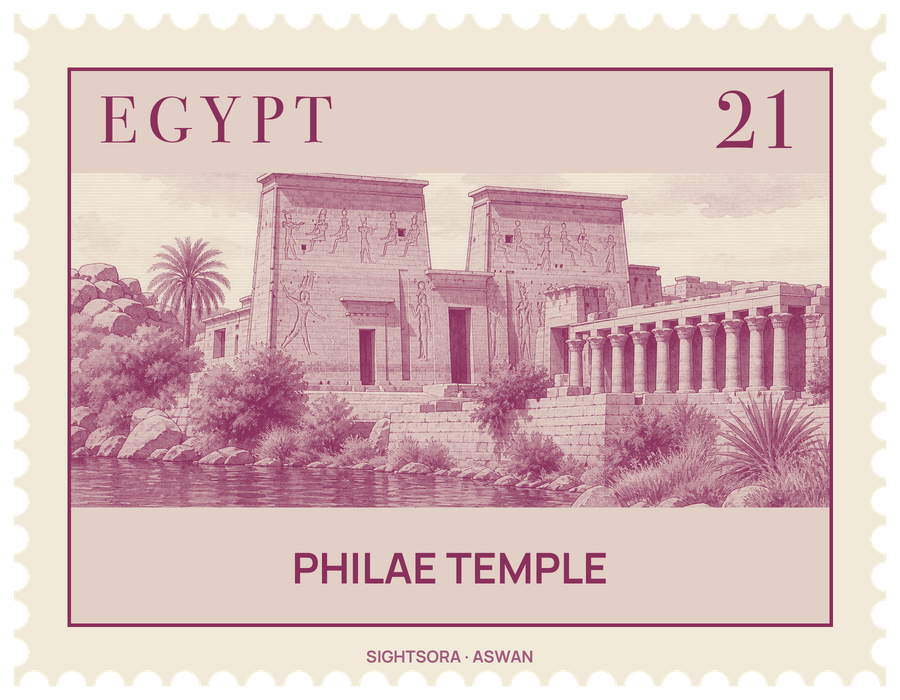
At their centre is the temple of Isis, mother of Horus, begun by Ptolemy II Philadelphus, and most of what visitors walk through dates from the Ptolemaic period. It was among the last places where the old Egyptian gods were worshipped: the temple kept functioning until Justinian I ordered the pagan temples closed, and the last dated hieroglyphic inscription, cut in 394 by Esmet-Akhom, one of the priests of Isis, is on its walls.
The rescue was a long story. After the British completed the Aswan Low Dam in 1902, and especially once it was raised twice, the island spent most of the year under water, which washed the colour from the reliefs and coated the stones in silt. When the High Dam threatened to drown it completely, UNESCO member countries backed an international competition to save it as part of the campaign for the monuments of Nubia. Behind a cofferdam the site was drained, the buildings were measured by photogrammetry and taken apart into about 40,000 blocks, and they were reassembled some 500 metres away on Agilkia, which had been levelled and shaped to match the contours of old Philae, 12.40 metres higher than before.
The temple of Isis is entered through great pylons, and older pieces are built into it: a kiosk and a gateway from the reign of Nectanebo I, the gateway now part of the first pylon. Greek inscriptions on the pylons are cut through by Egyptian figures carved across them. In the mammisi, the birth house where the birth of Horus was celebrated, a scene shows Isis nursing the infant Horus in the marshes, and the story of Osiris runs across the walls of the inner chambers. Many figures were deliberately hacked away by early Christians when the temple of Isis was turned into a church of Saint Stephen, yet images of Horus and his winged sun disk were often spared.
Nearby stands a temple to Hathor built by Ptolemy VI Philometor and Augustus, whose columns are crowned with the goddess's head. The best-known silhouette on the island is the Kiosk of Trajan, which once fronted the temple complex: its roof has gone, but its regular rows of columns still stand and were drawn and described by travellers for generations. Its reliefs show the emperor making offerings to Isis, Osiris and Horus. In the Ptolemaic period Philae drew pilgrims from Egypt and Nubia and from as far away as Anatolia, Crete and the Greek mainland, and later visitors, among them the novelist Amelia Edwards in 1873–1874, wrote of the island rising from the river as the boat approached.