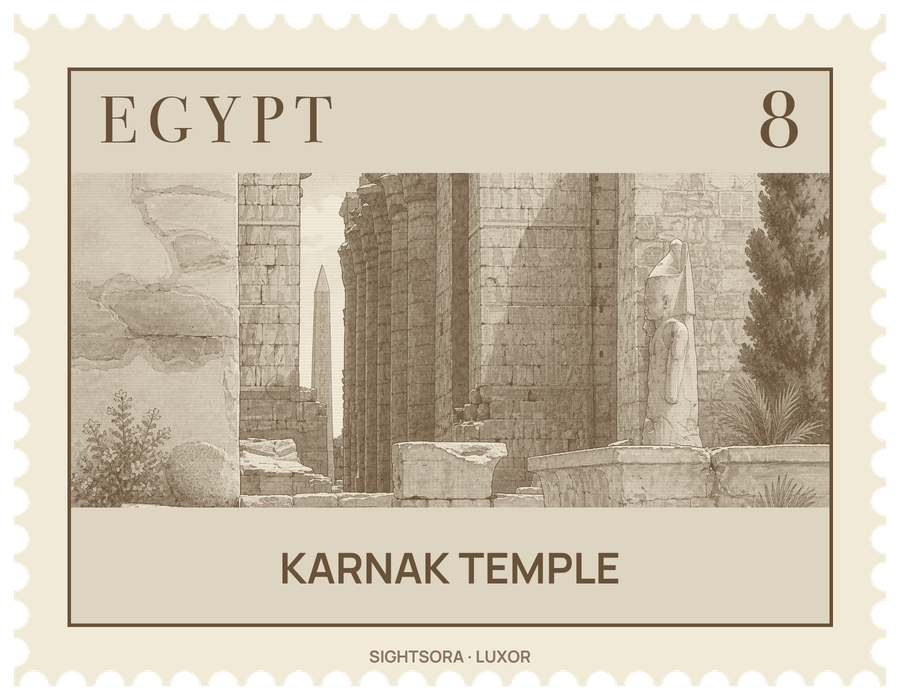
The Egyptians called it Ipet-isut, "The Most Select of Places". Building began under Senusret I in the Middle Kingdom and went on into Ptolemaic times, and about thirty pharaohs added to it, which is why the site is so large and so varied; most of what stands dates from the New Kingdom. As part of ancient Thebes, it was inscribed on the UNESCO World Heritage List in 1979.
The heart of Karnak, and the part most visitors mean by the name, is the Precinct of Amun-Re, the largest of its four main sections. It was entered through the First Pylon, 113 m long and 43 m high, built with the massive enclosure walls by Nectanebo I of the Thirtieth Dynasty, the last major change to its plan. Its sandstone, columns included, was brought by river from Gebel Silsila, 161 km to the south. Among its colossal statues is a figure of Pinedjem I, 10.5 metres tall, and an open-air museum lies within the site.
Beyond the pylon lies the Great Hypostyle Hall, 5,000 square metres crowded with 134 columns in 16 rows. Most are 10 metres high, but the other 12 reach 21 metres, more than 3 metres thick, and the stone beams across their tops weigh around 70 tons each. Seti I and Ramesses II did most of the building here in the Nineteenth Dynasty, and the capitals are carved as papyrus plants, some open and some closed. An unfinished column, set in an out-of-the-way spot, shows that the final carving was done only after the drums were in place.
Deeper in the precinct, Thutmose I's enclosure between the Fourth and Fifth pylons is the oldest part of the temple still standing where it was built. Hatshepsut set up twin obelisks at the entrance of the temple; one is still upright, while its partner fell and lies broken. Another obelisk in the precinct stands 29 metres tall and weighs 328 tons. Thutmose III's Festival Hall was turned into a church after the temples were closed in the 4th century, and painted saints and Coptic inscriptions can still be made out in it, while the Sacred Lake of the precinct lies nearby.
South of the Amun-Re precinct is the Precinct of Mut, the mother goddess and Amun's wife, with smaller temples and a crescent-shaped sacred lake of its own; excavators recovered six hundred statues of black granite from the courtyard of her temple. The smaller Precinct of Montu, the war god, lies to the north, and east of the main complex once stood a temple of Amenhotep IV (Akhenaten), so thoroughly demolished after his death that its layout is unknown. From the Cachette Court, where Merneptah recorded his victories over the Sea Peoples, a processional road lined with sphinxes once ran south to the Luxor Temple.