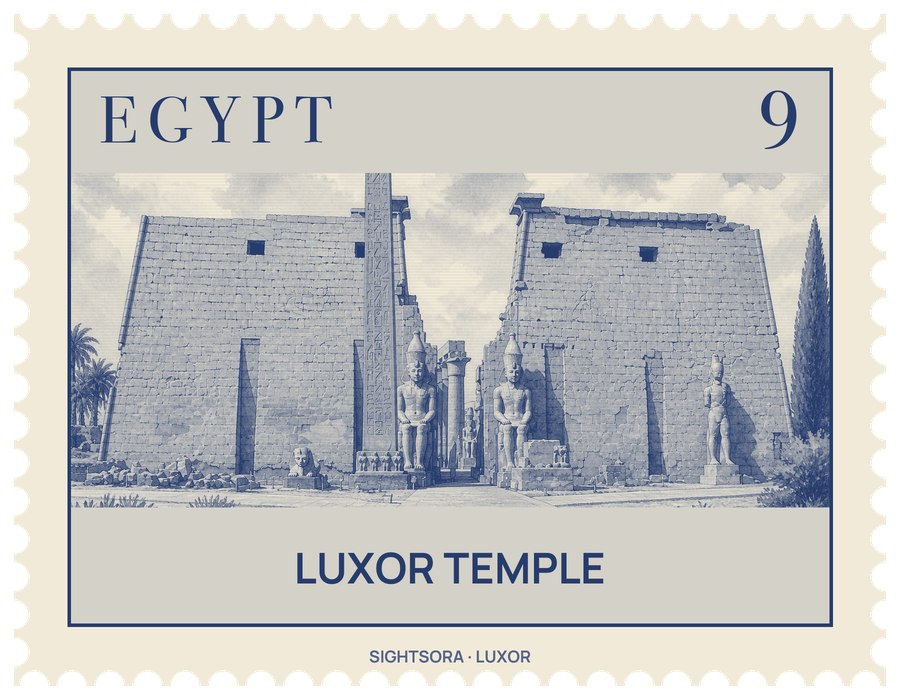
The Egyptians called it ipet resyt, "the southern sanctuary", and it was one of the two great temples of the east bank, the other being Karnak. It was dedicated to the Theban Triad, Amun with Mut and Khonsu, his consort and son, but its deeper subject was kingship itself: rather than a god or a dead pharaoh, it celebrated the renewal of royal power, and kings may have been crowned here, in fact or in idea. Alexander the Great claimed a coronation at Luxor.
The approach shows this royal theme. Before the pylon of Ramesses II sit colossal statues of the deified king, and more stand at the entrance to the great colonnade; they are cult images of the royal ka, the king's divine spirit. Two obelisks once flanked the gate, cut to different heights but placed so that they looked equal from the front; only one remains, as the smaller western one stands in the Place de la Concorde in Paris. The temple is built of Nubian sandstone from the Gebel el-Silsila area.
Inside, the courts and colonnades lead to the sun court of Amenhotep III of the 18th Dynasty, who built the chapels at the back of the temple; Tutankhamun and Ramesses II added other parts, and Alexander a chapel of his own at the rear. A double statue of Amun and Mut bears the faces of Tutankhamun and Ankhesenamun. Roman soldiers later turned the temple and the ground around it into a legionary fortress, and a chapel first built for Mut was turned into a shrine of the Tetrarchy and then a church.
Once a year, during the Opet Festival, the cult statue of Amun travelled from Karnak to stay here with Mut. The road between the two temples, about 2.7 kilometres long and perfectly straight, was lined with human-headed sphinxes and had six way stations where the sacred barques of the gods rested during processions.
From the Middle Ages the people of Luxor lived in and around the temple, and their rubble built up into a mound 14.5 to 15 metres high that buried three quarters of it. Gaston Maspero began clearing the houses, barracks and pigeon towers after 1884, though excavation went on in fits and starts until 1960. One building was never removed: the Abu Haggag Mosque, which stands within the temple on top of its ancient columns, in a part of the complex that the Romans had already made into a church in 395.