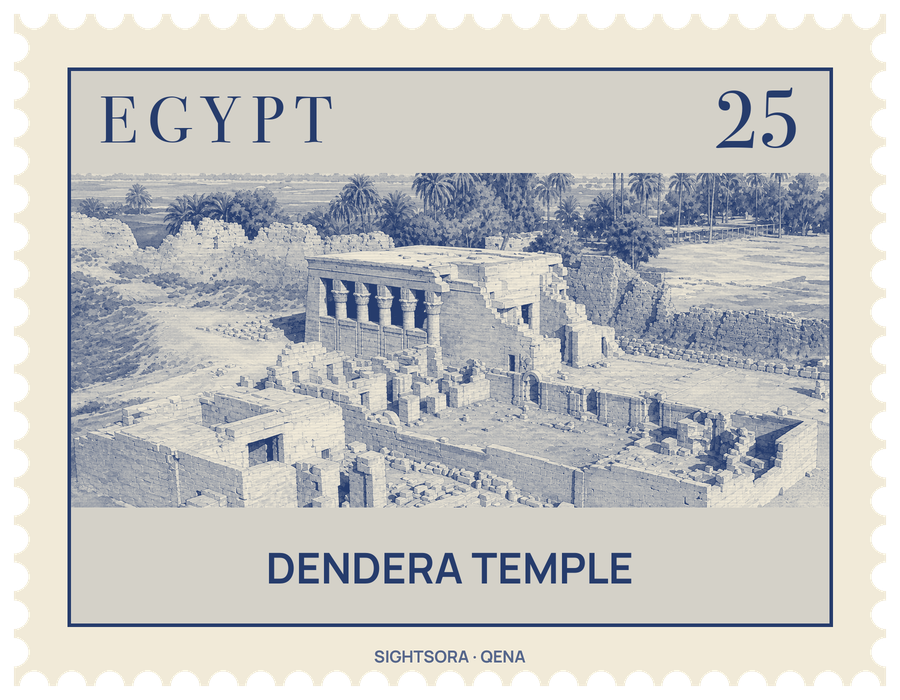
Worship here goes back a long way: there are signs of a building from around 2250 BC, possibly begun under Pepi I, and of a temple of the Eighteenth Dynasty. The temple that stands today, however, was begun in 54 BC under Ptolemy XII Auletes, and its hypostyle hall was added under the Roman emperor Tiberius. In the 19th century English writers spelled the name Tentyra.
The temple is unusually complete, which lets visitors follow its plan from the columned hypostyle hall to the main sanctuary, the Great Seat, with a series of shrines including those of Hathor's sistrum and of the throne of Ra. Restoration work has cleaned the Great Pillars Hall and brought back the original colours of the painted scenes on its walls and ceilings. On the outer face of the rear wall, Cleopatra VII is carved together with Caesarion, her son by Julius Caesar, and the Roman emperors Trajan and Domitian appear making offerings on the temple's monumental gateway.
Several parts of the temple reward a closer look. Twelve chambers lie in crypts beneath it, decorated with reliefs of the vessels and divine images once stored there; in one, Pepi I presents a small figure of Ihy to four images of Hathor, the young god's mother. A processional staircase climbs to the roof, its walls carved with rituals and its steps so worn and encrusted over the centuries that it has been nicknamed the melted stairs; up on the roof stands the Kiosk of Hathor. Inside, reliefs show the god Harsomtus as a snake rising from a lotus within an oval container, which 20th-century pseudoarchaeologists claimed was an electric light bulb.
The ceiling once held the Dendera zodiac, a carved map of the sky that includes signs still used today, such as Taurus and Libra. Frenchmen removed it in the 19th century, the original is in the Louvre, and a copy has taken its place. Jean-François Champollion dated it to the Ptolemaic period, and Egyptologists now place it in the first century BC.
Around the main temple stand other buildings of the complex: the mammisi of Nectanebo II, the oldest building still standing in the compound, a Roman mammisi whose reliefs show Trajan dressed as a pharaoh making offerings to Egyptian gods, the Temple of the birth of Isis, the sacred lake that supplied water for rituals and daily use, a sanatorium where the sick bathed in sacred water and slept in hope of healing dreams, and the gateways of Domitian and Trajan.