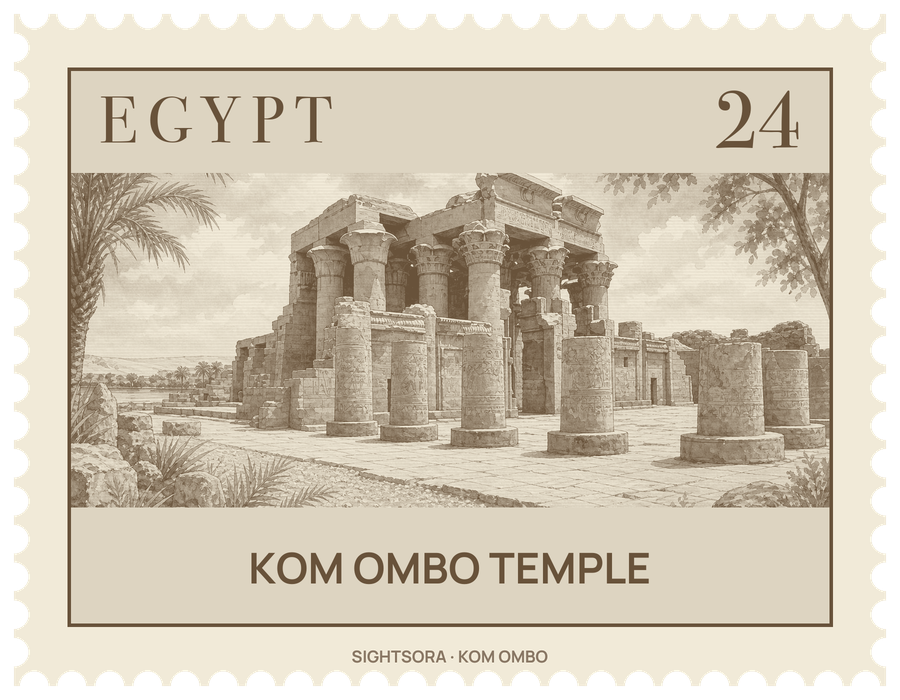
The southern half belongs to the crocodile god Sobek, worshipped as the bringer of fertility who created the world, together with Hathor and Khonsu. The northern half is the domain of Haroeris, Horus the Elder, the falcon god, with Panebtawy, Lord of the Two Lands, and Tasenetnofret, the Good Sister. The whole plan is laid out in strict symmetry along that axis.
The temple dates from the Ptolemaic dynasty. Ptolemy VI Philometor began it early in his reign, later Ptolemies added to it, and Ptolemy XIII built the inner and outer hypostyle halls; the Romans made further additions. An older temple to the same gods had stood here in the New Kingdom, though little of it survives. The town's ancient name, NBU, meant gold, and the Greeks and Romans called it OMBOS; with the Arabic kom, a mound, the modern name comes out as Mound of Gold.
Much of the building has been lost to the Nile, to earthquakes and to later builders who took its stones, and some reliefs were defaced by Copts who once used it as a church. Jacques de Morgan cleared the debris from the temple buildings on the southern side of the plateau and restored them in 1893. Visitors can still see well-preserved friezes, columns shaped like papyrus plants holding up stretches of ceiling, and a relief of Ptolemy VI making an offering to Hathor and Horus. On the inside of the back wall, one scene draws particular attention because it probably shows a set of surgical instruments. Around three hundred crocodile mummies were found in the area, and a few of them are on show in the Crocodile Museum.