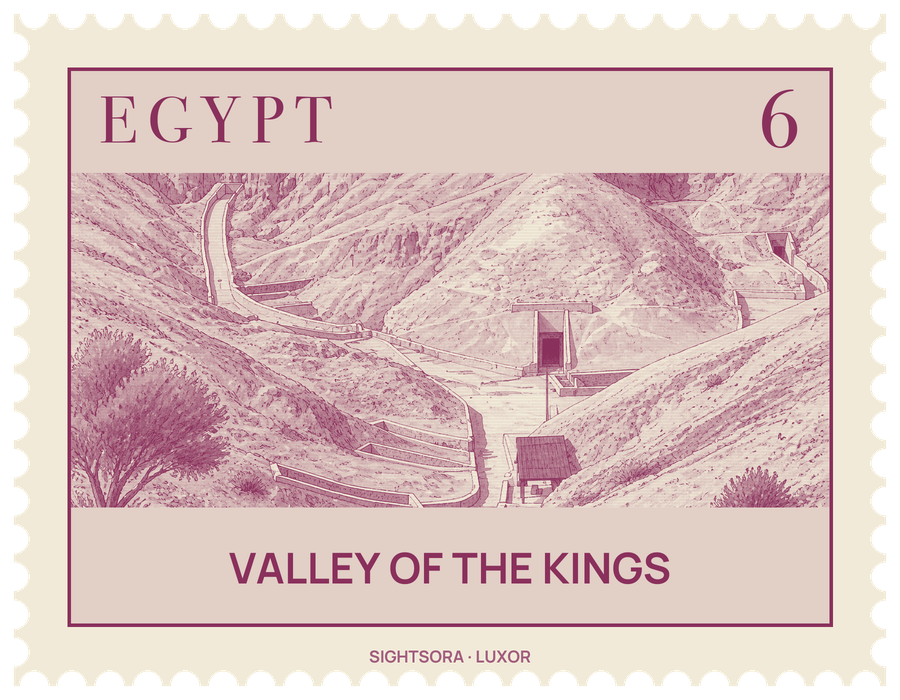
The valley has two arms: the East Valley, which holds most of the royal tombs, and the quieter West Valley, also called the Valley of the Monkeys. Above it rises al-Qurn, a pyramid-shaped peak the ancient Egyptians called "The Peak", and its remote position made the burials easier to guard. With the rest of the Theban Necropolis, the valley became a UNESCO World Heritage Site in 1979.
Some 65 tombs and chambers are known, from the bare pit of KV54 to KV5, a tomb of more than 120 chambers that Ramesses II enlarged for his sons. Only about twenty held kings; the others belonged to queens, princes and favoured nobles. The tombs carry numbers prefixed KV, for "Kings' Valley", a system begun in 1827 when John Gardner Wilkinson painted numbers over the 21 entrances then open. The workers who cut and painted them lived in the village of Deir el-Medina, in a small valley between here and the Valley of the Queens.
A typical royal tomb is a long sloping corridor driven into the hill through one or more halls to the burial chamber, perhaps echoing the sun god's descent into the underworld. Early tombs bend sharply, at least once at a right angle, while later ones run straighter and less steeply. The walls are covered in religious texts and images that follow the sun through the twelve hours of night: the Amduat in the early tombs, the Book of Gates from Horemheb's reign, and later the Book of Caverns and the Book of the Earth, with the night sky painted on the burial chamber ceilings from Seti I onwards.
Among the best known tombs is KV62, which Howard Carter found on 4 November 1922: Tutankhamun's tomb, the first royal tomb found still largely intact, although robbers had entered it. Seti I's KV17, found by Belzoni in 1817 and richly carved and painted, is often counted the finest in the valley. KV11 of Ramesses III, also called the Harper's Tomb, is a vast tomb in the middle of the valley, close to the central rest area, and KV9, shared by Ramesses V and Ramesses VI, is lined with sunk reliefs and holds over a thousand graffiti left by Greek, Roman and Coptic visitors. Ramesses I's short tomb, KV16, keeps vivid colours and the king's sarcophagus, and Merenptah's runs 160 metres into the rock.
Almost every tomb was robbed in antiquity; papyri describe the trials of tomb robbers in the late Twentieth Dynasty. To protect the dead kings, priests of Amun later emptied many tombs and gathered the mummies in hidden caches, above all one near Deir el-Bahari in the cliffs over the temple of Hatshepsut, where at least forty royal mummies were found. Visitors came even in Roman times, and their graffiti still mark the walls of several tombs.