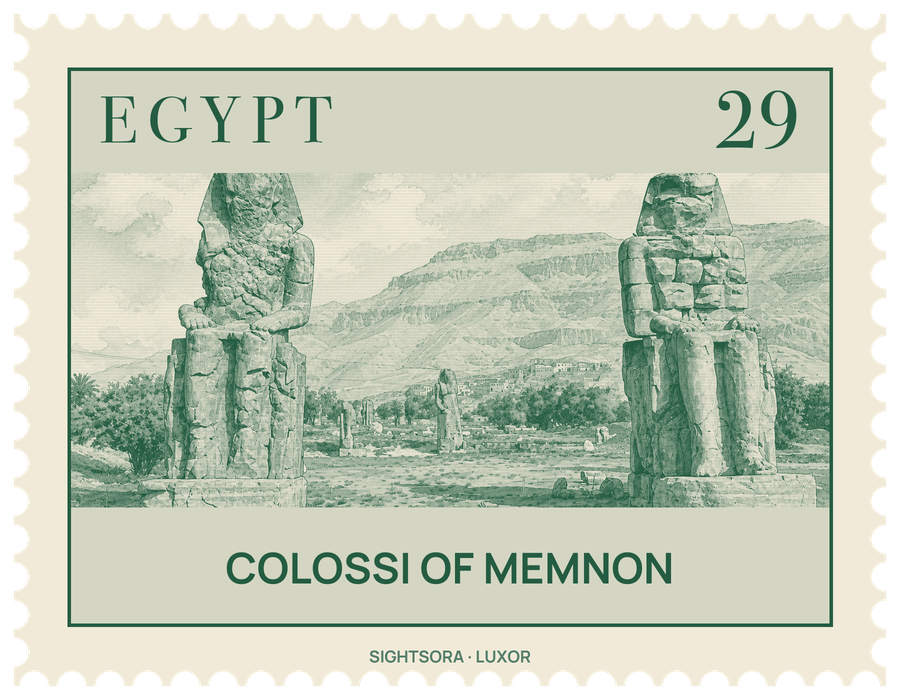
With the platforms they sit on, each reaches 18 metres and weighs an estimated 720 tons, and they stand about 15 metres apart. They once guarded the entrance to Amenhotep's vast mortuary temple, a temple in which the king was revered as a living god; floods, earthquakes and later builders who took its stone left little of it besides the two colossi.
The statues are cut from quartzite sandstone quarried at el-Gabal el-Ahmar, near Cairo, and hauled 675 kilometres overland to Thebes. Both are badly worn, their features above the waist almost gone. Beside the king's legs, smaller figures of his wife Tiye and his mother Mutemwiya are carved on the front of the throne, and the side panels show the Nile god Hapi. The southern statue is a single block of stone; the northern one is cracked through its lower half and, above the waist, built up from 5 tiers of a different sandstone, added in Roman times after an earthquake in 27 BC shattered it. Local tradition credits that repair to the emperor Septimius Severus.
The name Memnon comes from the northern statue's strange voice. After the earthquake, the broken figure was said to sing within an hour or two of sunrise, a sound Strabo likened to a blow and Pausanias to a snapping lyre string, and visitors linked it to Memnon, the hero of the Trojan War and son of Eos, goddess of the dawn. The singing drew travellers from across the Roman world, emperors among them, until it fell silent, probably once the upper tiers added weight. If the cause was natural, it was most likely warming air drying dew inside the porous stone.
Those visitors left their mark: 107 inscriptions in Greek and Latin cover the statues, dated between AD 20 and 250, many reporting whether the writer heard the sound or not. Among them are poems by Julia Balbilla, who came in November 130 with Hadrian and the empress Vibia Sabina. Behind the colossi, excavations led by Hourig Sourouzian have shown that the temple had three pylons, each fronted by colossal statues, and a peristyle court at its far end.