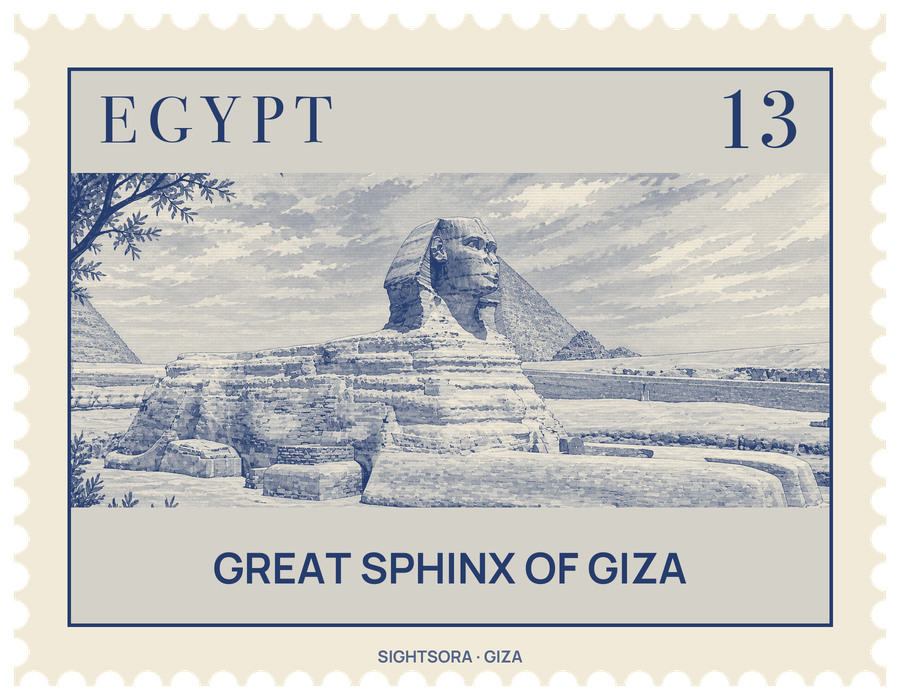
The Great Sphinx was not built but carved straight out of the limestone bedrock of the plateau, the same rock that was quarried for the pyramids around it. It measures 73 m from paws to tail, 20 m from the base to the top of its head and 19 m across the rear haunches, and it is part of the Memphite Necropolis World Heritage Site.
The archaeological evidence places it between 2600 and 2500 BC, in the Old Kingdom, during the reign of either Khufu, builder of the Great Pyramid, or his son Khafre, builder of the second pyramid; whose face it shows is still debated. It lies beside Khafre's valley temple and causeway, and the stone cut away from around its body was used for a temple in front of it, which, like the enclosure, was never finished. Its original name is unknown. In the New Kingdom it was worshipped as the sun god Hor-em-akhet, "Horus of the Horizon", and Amenhotep II built a temple to him northeast of the statue; the name "sphinx" came later, from the Greeks, and the Arabic name Abū il-Hawl means "father of terror".
Sand has buried the Sphinx again and again, at times up to its shoulders. Around 1400 BC the young prince Thutmose IV dug out its front paws and set up between them the Dream Stele, a granite slab that tells how the Sphinx promised him the throne in a dream if he freed it from the sand; the stele still stands between the paws. In the first century AD a broad stairway more than 12 metres wide was built down to the paws, and in 1817 Giovanni Battista Caviglia led the first modern dig, which uncovered the chest completely.
The face has lost its nose. Marks of rods or chisels hammered in at the bridge and below the nostril show it was pried off on purpose, and it was already damaged by the 10th century; the familiar story that Napoleon's soldiers shot it off with cannon is a myth. Pieces of a ceremonial beard were found between the paws, and traces of red pigment can still be seen on the face, while yellow and blue have been found elsewhere on the body, so the statue was once brightly painted.
The rock itself is uneven. The legs and lowest part of the body are solid bedrock, the softer layer of the middle body has worn away badly in the wind and blowing sand, and the head is carved from a harder limestone that has held up better. Repairs have left their own marks: in 1931 a concrete collar was added between the headdress and the neck after part of the headdress fell off in 1926, and the stone base was renovated in the 1980s and again in the 1990s.