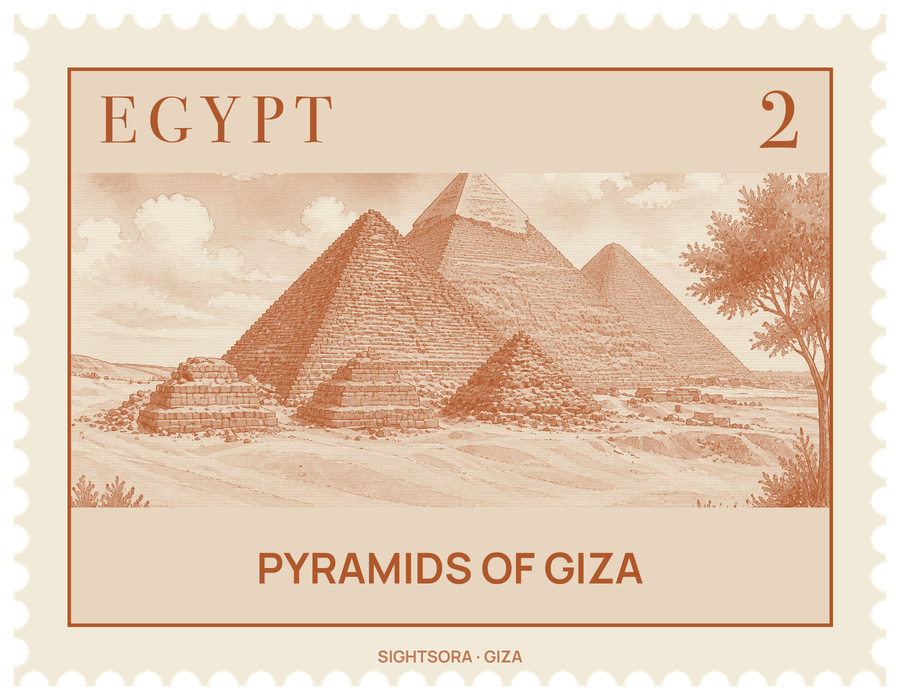
All belong to the Fourth Dynasty of the Old Kingdom and went up between about 2600 and 2500 BC for three generations of one family: Khufu, his son Khafre and Khafre's son Menkaure. The plateau forms the northern end of a UNESCO World Heritage Site inscribed in 1979, Memphis and its Necropolis with its pyramid fields, which also takes in the pyramids of Abusir, Saqqara and Dahshur.
Each pyramid was a king's tomb and the heart of a complex of its own: a valley temple, a causeway leading up from it, a mortuary temple against the pyramid, smaller queens' pyramids and pits dug for boats. The Egyptians held that part of the king's spirit, his ka, stayed with his body, and the sloping sides were tied to the rays of the sun god Ra, giving the dead ruler a ramp towards the sky. The three stand in a line running south-west from Khufu's Great Pyramid, with Khafre's a few hundred metres beyond it and the far smaller pyramid of Menkaure farther on, all set square to the points of the compass within one-fifteenth of a degree. Most of their limestone came from the bedrock of the plateau itself.
Khafre's pyramid looks taller than Khufu's because it sits on higher ground and climbs at a steeper angle, though it falls short of Khufu's in both height and volume; near its tip it still wears a cap of its original casing. His valley temple, next to the Sphinx temple, yielded several statues of the king, some of them pulled from a well in its floor by Mariette in 1860. Menkaure's pyramid, completed around 2510 BC, is the one major monument that has lost every piece of its polished limestone facing; three queens' pyramids stand beside it, and statues of Menkaure came out of both its valley and mortuary temples.
Around the pyramids, mastaba tombs for lesser royals and officials were laid out along streets and avenues. The East Field, next to Khufu's queens' pyramids, holds Cemetery G 7000 with the tombs of his wives, sons and daughters, while in the West Field his sons Wepemnofret and Hemiunu were buried in Cemeteries G 1200 and G 4000. In the Central Field, close to Menkaure's valley temple, Queen Khentkaus I had her own pyramid complex with a valley temple, a pit for a boat and a small town attached to the pyramid. Building did not stop with the Old Kingdom: Amenhotep II raised a temple near the Sphinx in the New Kingdom, and a temple to Isis Mistress-of-the-Pyramids was rebuilt in the 21st Dynasty.
A large stone wall encloses the plateau, and outside it, south-east of the Khafre and Menkaure complexes, Mark Lehner's team found the town where the builders lived, with shared sleeping quarters, bakeries, breweries and kitchens, a hospital, a cemetery and a workshop for copper; bread, beef and fish were their staple foods. The workers' own mudbrick tombs, found beside the pyramids from 1990, were supplied with beer and bread for the afterlife, and their placement and care point to paid labourers rather than slaves. Evidence from these tombs suggests a workforce of about 10,000 men, rotating in three-month shifts, needed around 30 years for a single pyramid.