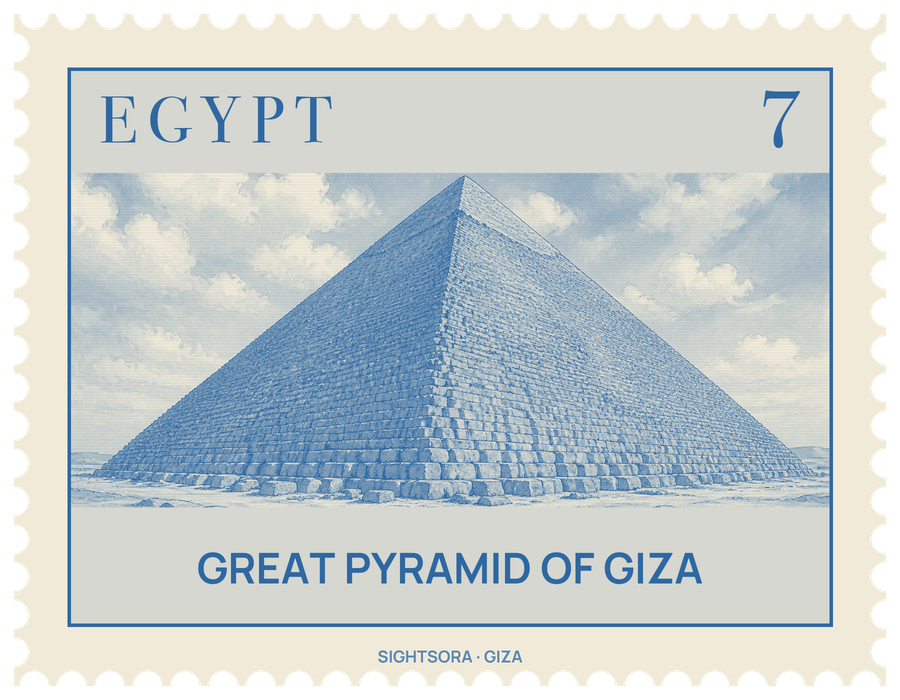
It first stood 146.6 metres high, and for more than 3,700 years nothing built by people rose higher. With most of its smooth white facing gone, it now reaches 138.5 metres, and what visitors see is the core structure beneath; each side of the base runs about 230.3 metres. Among the ancient world's Seven Wonders it is both the earliest and the only one still largely standing.
Some 2.3 million blocks went into it. Most were cut from the plateau just south of the pyramid, a limestone full of fossil shells whose small discs can still be picked out in some stones. The white limestone for the outer casing was quarried at Tura, about 10 km away on the other side of the Nile, and ferried over by boat, and granite for the King's Chamber was shipped from Aswan, more than 900 km south, in blocks of up to 80 tonnes. The casing was stripped in the Middle Ages and taken away in 1356 for building in Cairo; a few stones of the lowest course survive on each side, best on the north below the entrances. The base is set square to true north within about a tenth of a degree.
Visitors go in through the Robbers' Tunnel, forced into the north face about 7 metres above the base and traditionally credited to the workmen of Caliph al-Ma'mun around 820 AD, though it may be older. It joins the Ascending Passage, whose lower end is still plugged by three granite blocks that the builders slid down to seal it, and leads to the Grand Gallery: a sloping hall 8.6 metres high and 46.68 metres long, with polished limestone walls that step inwards seven times towards a narrow roof. A horizontal corridor from the foot of the gallery runs to the so-called Queen's Chamber, which has a pointed roof and lies at the midpoint between the pyramid's northern and southern sides.
At the top of the gallery, a low antechamber that once held stone portcullises opens into the King's Chamber, lined entirely with granite and roofed by nine slabs weighing about 400 tons together. Its walls are bare, as was usual for burial chambers of the period, and the only object left is Khufu's granite sarcophagus, cut from a single block, broken open and lidless; it is too big to have passed through the corridors, so it must have been placed before the roof went on. Two narrow shafts lead out of the north and south walls. Above the ceiling are five relieving chambers, reached in 1837, whose blocks carry red-painted marks of the work gangs, including names of Khufu.
Little remains of the buildings that served the king's cult: of the Pyramid Temple on the east side only some black basalt paving survives, and the Valley Temple lies under the village of Nazlet el-Samman. On the east side stand three smaller pyramids known as the Queens' Pyramids, and 110 metres east of the Great Pyramid is the tomb of Queen Hetepheres I, Khufu's mother, found intact but with an empty coffin. Pits for boats lie around the pyramid; one on the south side, opened in 1954, held 1,224 pieces of wood that were pieced together into a cedar boat 43.6 metres long, now in the Grand Egyptian Museum.