The site was sacred long before that. Kings of the First Dynasty, Narmer and Aha among them, were buried in the desert here, and as the Old Kingdom drew to a close Abydos became the centre of the cult of Osiris, with a tradition that the god himself lay in its early royal cemetery. Wealthy families across Egypt recorded pilgrimages to it in their tomb decoration.
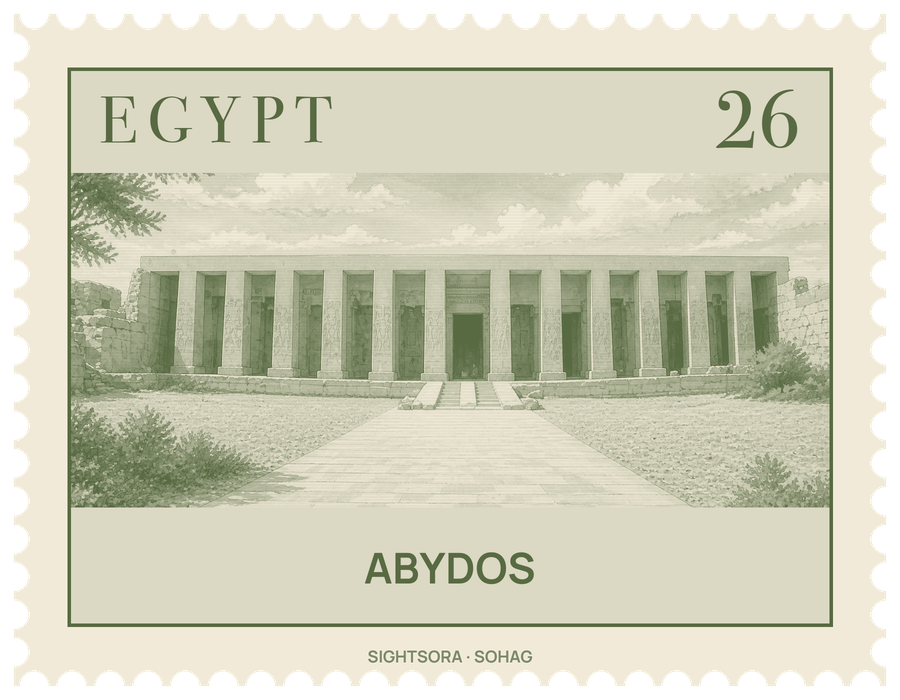
Seti I built his temple on fresh ground south of the old town, to honour the early pharaohs as well as himself, and Ramesses II completed it. Its seven chapels are dedicated to the king and to Ptah, Re-Horakhty, Amun and the three gods of Abydos, Osiris, Isis and Horus; the rites carved in them are the first complete version known of the Daily Ritual performed in Egypt's temples. In the Gallery of Ancestors, Seti and Ramesses make offerings before the Abydos King List, a row of royal cartouches running from Menes to Seti's father Ramesses I; some rulers, such as the Hyksos and Akhenaten, are left out. Over one arch, a carving of Seti I was plastered over and recut under Ramesses II, and as the plaster fell away the two overlapping inscriptions produced shapes that have been read as a helicopter.
Behind the temple lies the Osireion, a structure built to resemble a royal tomb in the Valley of the Kings and linked to the worship of Osiris; parts of it now stand in water because of the Aswan Dam and rising floodwaters. The walls of the temple also carry ancient Phoenician and Aramaic graffiti. Nearby, the smaller temple of Ramesses II keeps the lower parts of its outer reliefs, which show the Battle of Kadesh; its own list of kings was broken up, and in 1837 the French consul removed the pieces and sold them to the British Museum.
About a mile into the desert plain lies the royal cemetery of the earliest dynasties, Umm El Qa'ab; its name, Mother of Pots, comes from the shards of offerings left by pilgrims. Plunderers emptied most of its brick-lined tombs, though enough survived to show they once held jewellery, stone vessels, wine jars and ivory and ebony tablets recording each year of a reign. Behind the town stands the Shunet ez Zebib, a vast mudbrick funerary enclosure of Khasekhemwy, last king of the Second Dynasty, one wall of which still rises 30 feet; a Coptic Orthodox convent now stands inside another of these enclosures. Much of the ancient town and its great temple of Osiris lies buried under the modern buildings north of the Seti temple.