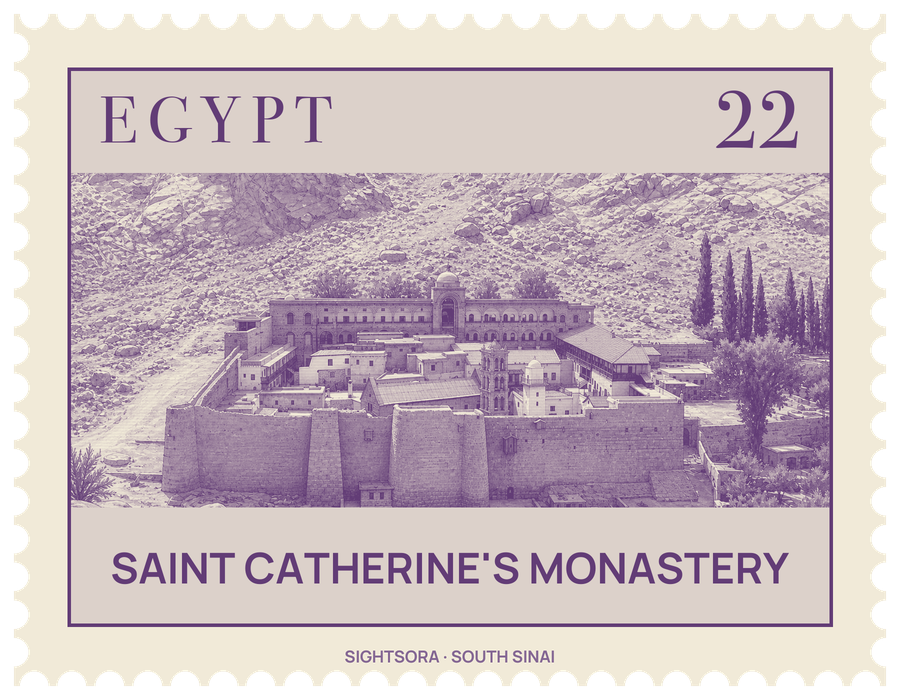
It encloses the spot where, by tradition, Moses saw the burning bush, and it belongs to the autonomous Church of Sinai, part of the wider Greek Orthodox Church, whose archbishop is also the monastery's abbot. It was added to the UNESCO World Heritage list in 2002 for its significance to Judaism, Christianity and Islam alike.
Three peaks form its backdrop: Willow Peak about a kilometre to the west, sometimes identified with the biblical Mount Horeb; Jebel Arrenziyeb to the south; and Mount Sinai itself, known locally as Jabal Musa, whose summit lies about 2 kilometres south. Until the twentieth century the only way in was a door set high in the outer wall. Inside, the Chapel of the Burning Bush, also called Saint Helen's Chapel after the mother of Constantine I, marks the holy site, and a centuries-old bramble in the grounds is venerated as the bush itself. The Well of Moses, where tradition says he met his future wife Zipporah, still supplies the monastery with water.
The monastery took its present name from Catherine of Alexandria. Centuries after its founding, a body believed to be hers was found in a cave nearby and brought here, and her relics, kept inside the monastery, made it a favoured place of pilgrimage. Within the walls there is also a Fatimid mosque of 1106, converted from an older chapel and used on special occasions. In the Middle Ages the monks were Arab, Greek, Syrian, Slavonic and Georgian; under the Ottomans the community became almost entirely Greek Orthodox. The monastery also keeps a copy of the Ashtiname, the document in which Muhammad is said to have granted it his protection.
The monastery's greatest treasures are its library and its icons. The library holds manuscripts in Greek, Syriac, Georgian, Arabic, Latin, Armenian, Church Slavonic and other languages, among them the Syriac Sinaiticus, an early Gospel palimpsest found here in 1892 by Agnes Smith Lewis. Part of the Codex Sinaiticus, a 4th-century Bible studied here by Constantin von Tischendorf, left for Russia in the 19th century and is now in the British Library. Because the monastery escaped Byzantine iconoclasm and was never sacked, it kept a few icons from the 5th and 6th centuries, painted in hot wax, including Christ Pantocrator and Saint Peter, as well as more than 120 icons in the Crusader style made around the monastery in the 13th century.
Travellers have described the place for centuries. A pilgrim named Egeria left the oldest account of monastic life at Mount Sinai in the 4th century; Felix Fabri in the 15th century recorded gardens with more than three thousand olive trees, figs, pomegranates and almonds; and Pierre Loti wrote about the monastery in Le désert, his 1895 account of crossing the Sinai by camel.