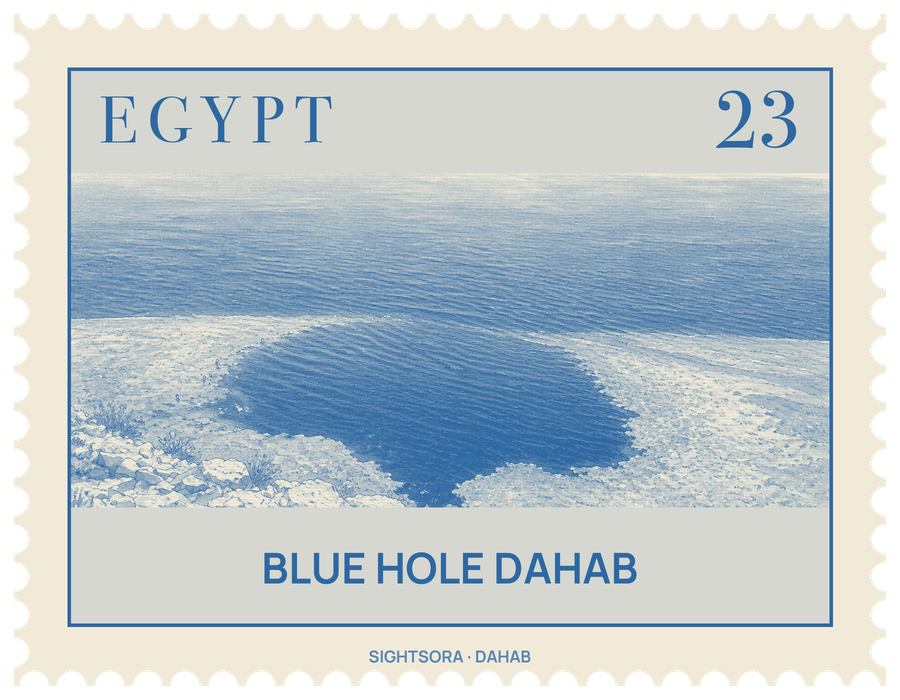
Two openings link it to the open sea. A shallow gap around 6 metres down, known as the saddle, crosses the rim towards the sea, while far deeper a tunnel 26 metres long, called the Arch, has its ceiling at 55 metres; beyond it, on the seaward side, the floor falls away steeply to over 1,000 metres. Coral and reef fish crowd the hole and the reef around it.
The Bedouin who lived along this coast traditionally kept away from the hole. Its fame as a dive site grew while Sinai was under Israeli occupation between 1967 and 1979; in 1968 Alex Shell and his team of Israeli divers became the first to go down with modern scuba gear and found the underwater arch. Since 1982 it has been dived almost daily, and it has also become a favourite place for freediving, because great depth can be reached straight from the shore and there is no current.
Most recreational dives here follow the Bells to Blue Hole route. Divers enter from the shore a little way along the coast at the Bells, pass a small arch at 26 metres, which is not the famous Arch, and follow the reef wall back to the Blue Hole, finishing by crossing the saddle at 7 metres. The Arch itself lies deeper than the 40 metres generally treated as the limit of recreational diving and is a technical dive that needs suitable training and equipment, so it is not seen on this route.