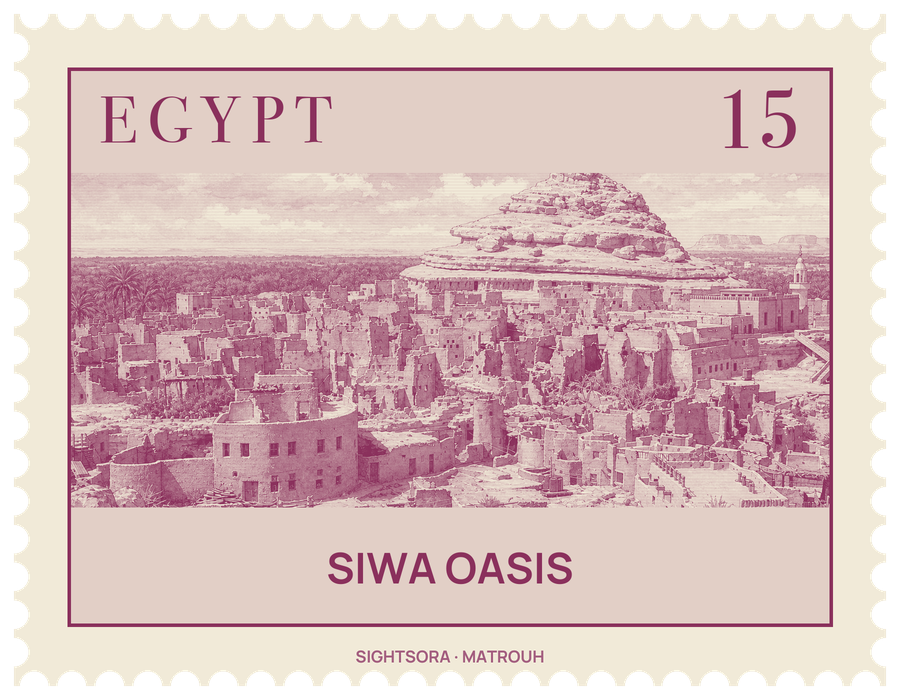
The oasis fills a hollow that drops to 19 metres below sea level, about 80 km long and 20 km wide, watered by some 200 natural springs and artesian wells; thousands of date palms and olive trees grow here, two large salt lakes lie in the depression, and limestone hills that the people call mountains rise from the plain. Dates have been its fame since ancient times and remain the core of its economy, with olives a distant second.
In antiquity Siwa was known as the Oasis of Amun-Ra, home to an oracle of Amun that the Greeks knew as Zeus Ammon. Greek settlers at Cyrene reached it in the 7th century BCE, and Alexander the Great made the desert crossing during his campaign against the Persian Empire, after founding Alexandria; his court historians claimed the oracle confirmed him as divine and as rightful pharaoh. The fragmentary remains of the oracle temple, some of its inscriptions from the 4th century BCE, stand among the ruins of Aghurmi.
Rising five stories above the modern town is the Shali, the old fortress-town of Siwa, built on an outcrop of rock from kershif, a mix of salt and mud-brick, with palm logs. Three days of heavy rain in 1926 damaged it badly, and people moved out to houses on the plain; slowly eroding and partly collapsed, it is most easily reached from its southwest side, where uneven lanes lead up into it between cracked walls. Only its mosque has been repaired. Other sights close by include the Mountain of the Dead (Gebel al Mawta), a Roman-era burial ground cut with dozens of tombs in the rock, and Cleopatra's Bath, an ancient natural spring; hot springs draw visitors too.
Before the 1980s, when a tarmac road reached it from the Mediterranean coast, Siwa was linked to the outside world only by camel tracks, and the isolation shaped a culture of its own. Most people are Siwi Berbers who speak their own Berber language, Siwi, the farthest east of the Berber-speaking communities, alongside Arabic, and they developed distinctive basketry, pottery, embroidery and silverwork. Women once wore heavy sets of silver at weddings, above all the adrim, a large disc hung from a round necklace called the aghraw, decorated with Berber symbols for health, fertility and protection; gold has largely replaced the silver, but the same patterns survive in women's embroidery.
The Siyaha Festival, held in honour of the oasis's patron saint Sidi Sulayman, belongs to Siwa alone. The men gather on Gabal Al-Dakrour, a mountain near the town, to share a meal of fattah, sing and settle their quarrels, while the women celebrate in the village with music and dancing; after three days the men march back to Sidi Solayman square in the centre to mark a new year begun in reconciliation.