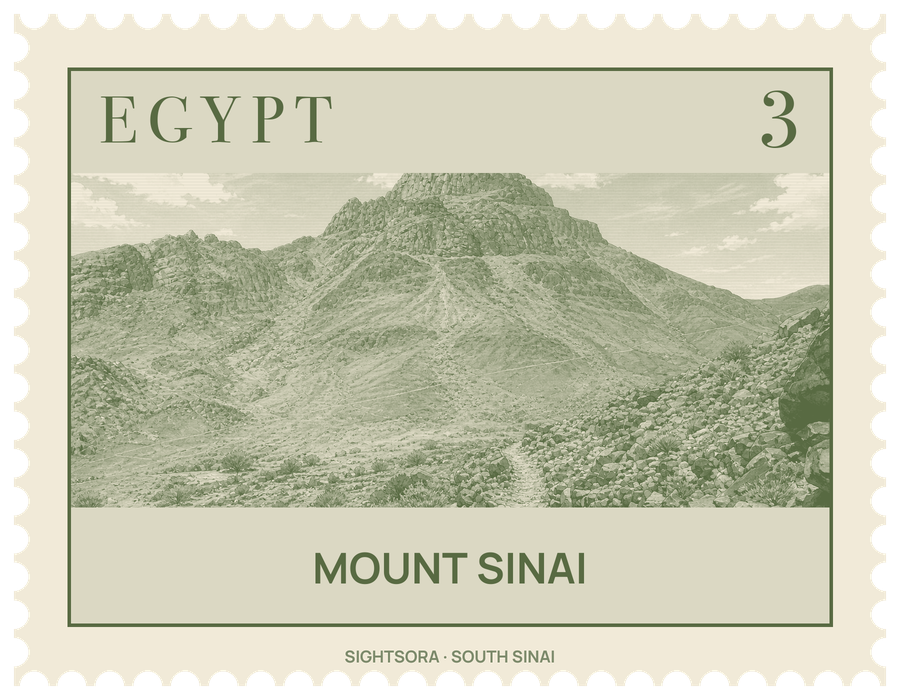
It is only one of several mountains proposed for that role, and Jewish tradition itself holds varying views on where the mountain of the Torah really lay. Higher summits ring it on every side, among them its neighbour Mount Catherine.
For Judaism this is where God gave Moses the Tablets of Stone and the rest of the Torah, an event remembered at the festival of Shavuot, when synagogues are decorated with flowers to recall the flowers said to have covered the mountain. In Islam the mountain is linked to the prophet Mūsā and appears in the Quran under several names, including Ṭūr Sīnīn and aṭ-Ṭūr, while the nearby Valley of Tuwa is regarded as sacred. Christians built Saint Catherine's Monastery in the 6th century at the foot of the mountain, immediately to its north, and the monastery can be seen far below from the top.
On the summit stands a small Greek Orthodox chapel, built in 1934 over what was left of a church from the 16th century; it encloses the rock believed to have supplied the stone for the tablets. Also at the top is Moses' cave, where the prophet is said to have waited to receive the commandments.
Two main paths lead up. Siket El Bashait, the longer and gentler of the two, is a walk of about 2.5 hours, and camels offer another way up. The steeper and more direct Siket Sayidna Musa climbs the ravine behind the monastery by the 3,750 "steps of penitence". Many walkers set off after midnight to reach the top in the dark for sunrise, while an afternoon climb to watch the sunset is quieter.