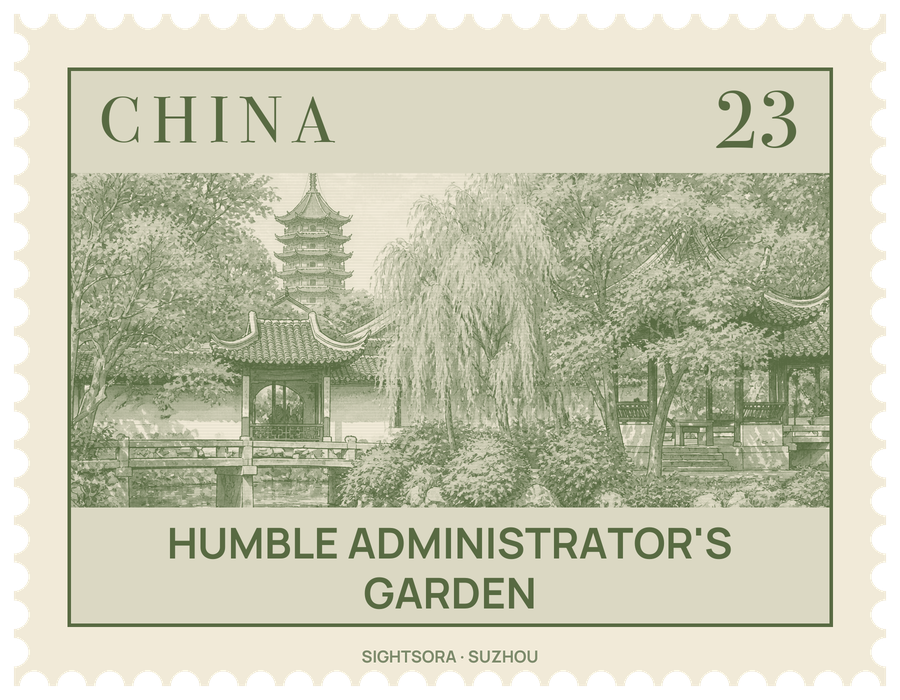
It belongs to the Classical Gardens of Suzhou, which UNESCO inscribed as a World Heritage Site in 1997.
Its present form goes back to 1513, when Wang Xianchen, a Ming dynasty imperial envoy and poet who had come home to Suzhou after a bruising official career, began building on the ruined site of the Dahong Temple. His friend, the Suzhou painter Wen Zhengming, took a close interest, and in 1533 painted an album of 31 scenes of the garden with poems. The name comes from a passage by the Jin dynasty scholar Pan Yue, who praised a retired official's life of planting trees and growing vegetables; for Wang it signalled a turn away from politics.
The garden passed through many hands after Wang's son lost it over gambling debts. In 1631 the eastern part was split off and renamed Dwelling Upon Return to the Countryside, the central part was bought and rebuilt in 1738, and in 1860 the Taiping prince Li Xiucheng lived here and remodelled it, a period said to account for much of what is seen today. The three parts were joined again in 1949, opened to the public and restored in 1952. Cao Xueqin, author of Dream of the Red Chamber, is thought to have lived here in his teens, and many scholars see the garden in the scenery of his novel.
Visitors move through three sections. The eastern garden opens around a wide lawn and pond ringed by crape myrtle, an allusion to the State Secretariat of the Tang dynasty, whose nickname was the Crape Myrtle Department. The central garden, the Zhuozheng Yuan, is arranged around the Surging Wave Pond, where three islands stand for the fairy islands of the eastern sea. The western garden, half the size of the central one, is again mostly water, with a pond running north to south around a small islet; it keeps its late nineteenth-century layout.
Across the whole garden there are 48 buildings, 101 tablets, 40 steles, 21 old trees of special value and more than 700 Suzhou-style penjing. The garden's curator, Xue Zhijian, names stone, plants, buildings and water as the four elements woven together here. In one corner rocks seem to break through a wall, as if the visitor were in mountains rather than a city, and the planting follows the seasons, with peonies, lotus, osmanthus and plum blossom.