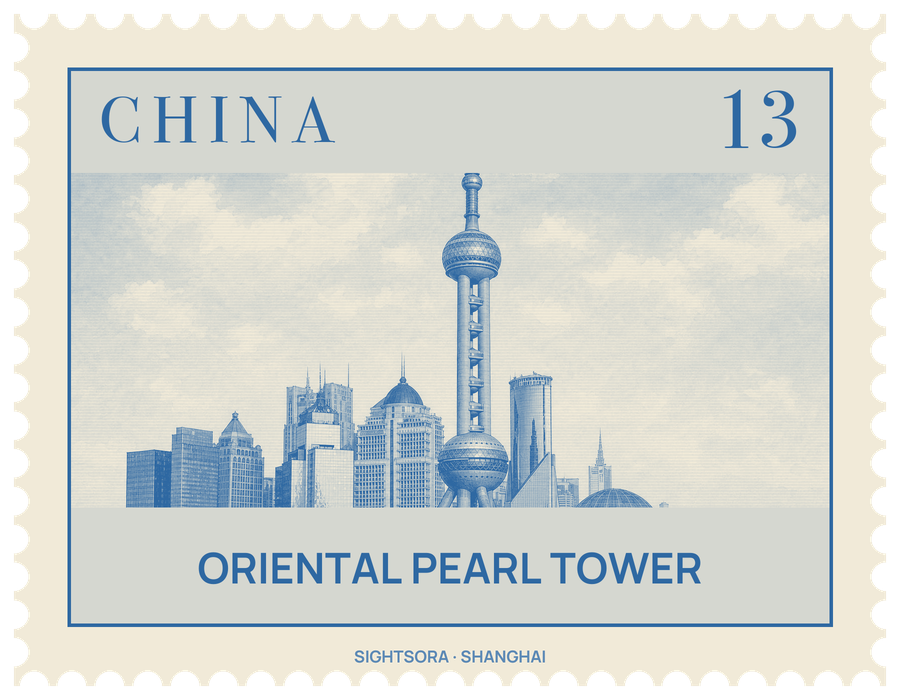
Its silhouette is easy to pick out: three large spheres strung on three pillars, rising to a top floor at 351 metres and, with the 137-metre antenna, a total height of 468 metres. It was Shanghai's first attraction to receive the AAAAA tourist rating, and since it opened it has become one of the images most associated with the city.
The tower grew out of a plan from 1983 to give Shanghai more broadcasting capacity and replace ageing transmitters. In 1984 the city chose a site in Lujiazui, a district then developing fast under reform and opening up, and the planned height was later raised from 400 to 468 metres. In 1988 three firms entered twelve designs, and the winner was the "Oriental Pearl" proposal from the East China Architectural Design Institute. Building began on 30 July 1991; the antenna went up in 1994 after 11 days of lifting, and the interior was finished that year.
The designers say the spheres, which reflect Shanghai's culture, were inspired by "Pipa xing", a poem by the Tang poet Bai Juyi. The spheres are built around a steel frame and clad in concrete tiles and laminated red glass. Because the riverside soil is soft, the tower stands on large concrete piles driven deep into the ground, reinforced with steel pipes and plates, a method later used for the nearby Jin Mao Tower.
Inside there are fifteen observation levels. The lower ones hold a revolving restaurant, an indoor roller coaster and museums, while several levels, the highest among them, have glass floors that let visitors look straight down. Between the two large spheres is the Space Hotel, a small hotel of 20 rooms.