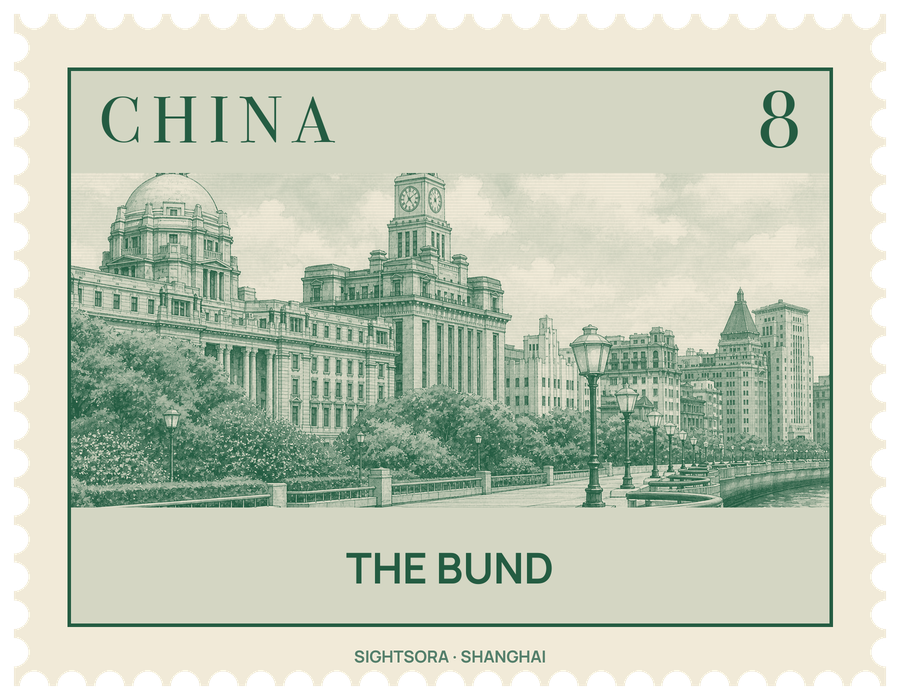
Across the water rise the towers of Lujiazui in Pudong, so a walk along the promenade sets the two faces of Shanghai side by side. Traditionally the Bund runs from Yan'an Road in the south to Waibaidu Bridge, the former Garden Bridge over Suzhou Creek, in the north, and it is a protected historical district.
The word bund came into English from Hindustani, meaning a dyke or embankment, and in the Chinese treaty ports it came to mean a quay built up along the shore. The Chinese name, by contrast, means "outer bank", setting it apart from the inner bank beside the old walled city to the south. The area began as a British settlement, merged with the American one in 1863 to form the International Settlement, and for some seventy years, between the 1860s and the 1930s, foreign wealth and power in Shanghai were concentrated here. Around the turn of the 20th century it filled with grand commercial buildings as it grew into a major financial centre, and by the 1940s most of the large financial institutions working in China had their headquarters here.
After the Communist victory many of these institutions relocated to Hong Kong during the 1950s, the hotels and clubs shut or took on other roles, and the statues of foreign figures along the river were taken down. From the late 1970s the buildings gradually went back to banking and hotel use. Repeated typhoon floods led the city to raise a levee about 10 metres above street level, and in a renovation completed for the 2010 World Expo the road traffic was partly moved into a tunnel so that the landscaped riverside promenade could be widened; the Bund reopened on 28 March 2010.
The architecture is a mix of Western revival styles, from Romanesque, Gothic and Renaissance to Baroque, Neo-Classical and Beaux-Arts, with a number of Art Deco buildings. Some deliberately echo the Three Graces on Liverpool's waterfront. Highlights along the row include the Shanghai Club at No. 2, once the main social club of the British; the Customs House at No. 13, built in 1927, whose clock and bell were made in England in imitation of Big Ben; the North China Daily News Building at No. 17; and Sassoon House at No. 20, built by Sir Victor Sassoon and now part of the Peace Hotel together with the Palace Hotel next door. The Bank of China Building at No. 23 is said to have been kept lower because Sassoon insisted that nothing on the Bund should top his building.
Near the Nanjing Road junction stands a bronze statue of Chen Yi, the first Communist mayor of Shanghai, the only bronze statue on the Bund. At the northern end, Huangpu Park holds the Shanghai People's Heroes Memorial Tower, an abstract concrete tower put up in 1993 for revolutionary martyrs and for those who died fighting natural disasters. The Gutzlaff Signal Tower, or Bund Weather Tower, once gave weather information to ships on the river; the present structure dates from 1907. After dark the main buildings on the Bund and in Pudong are lit up, and river cruises leave from nearby wharves.
Getting there
Shanghai Metro Line 2 passes under the Bund without stopping; East Nanjing Road station is the closest, around five minutes on foot up Nanjing Road. A ferry crosses the river from Jinling Road wharf, close to the Bund's southern end, to Dongchang Road wharf on the Lujiazui side, and the Bund Sightseeing Tunnel carries passengers under the river in slow people-mover cars with light effects projected on the tunnel walls.