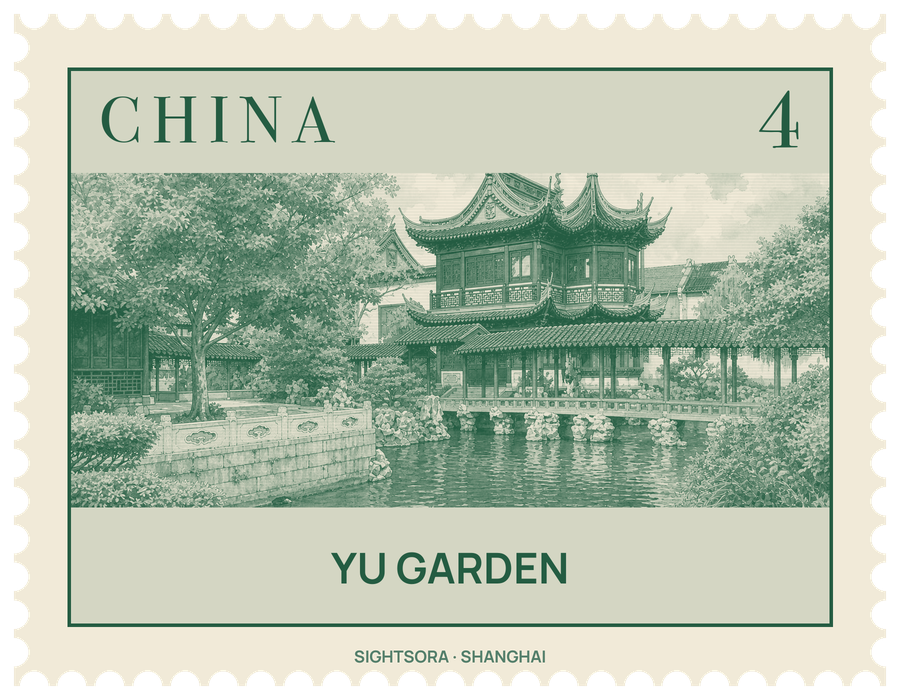
It covers about 2 hectares and holds more than 40 scenic spots, and it is protected as a key site at state level. The usual approach is over a zigzag Nine-turn bridge across a small pond with a teahouse, with the entrance off the forecourt at the far end.
Pan Yunduan began the garden in 1559 for his father, the minister Pan En, so that the old man would have somewhere pleasant to spend his last years. The name Yu means pleasing and satisfying one's parents, which is why it is also known as the Garden of Peace and Comfort. Pan's posting as governor of Sichuan held up the work until 1577. Once finished, the garden became a stage for the social life of the city: most of Pan's diary entries from 1586 to 1601 describe performances held there, mainly in the Leshou Tang hall. The cost of keeping it up eventually helped bring the family down.
After the Pans the garden changed hands many times. Part of it, today's East Garden, was bought by local leaders in 1709, merchants restored the run-down grounds in 1760, and the West Garden opened to the public in 1780. The 19th century was hard on it: British troops used the Huxinting Teahouse as a base for several days in 1842, and the Small Swords Society made its headquarters in Dianchun Hall from 1853 to 1855, after which almost none of the original buildings were left standing. Further damage in 1942 was repaired between 1956 and 1961, the garden reopened in 1961 and it was declared a national monument in 1982.
The layout follows the Jiangnan style of the Ming and Qing periods, divided into six areas in the Suzhou manner and separated by "dragon walls" topped by undulating ridges of grey tile. Sansui Hall looks onto the Grand Rockery, a 12-metre mass of huangshi stone shaped into peaks, cliffs, caves and gorges. Wanhua Chamber has a ginkgo about 400 years old in its front courtyard; Dianchun Hall dates from 1820; Yuhua Hall is furnished with Ming rosewood; Huijing Hall has the Jade Water Corridor and the Nine Lion Study; and the Inner Garden was formed in 1956 by joining its east and west parts. Each area was given its own theme, such as harvest and long life, flowers and stones, or spring and sunlight.
A highlight is the Exquisite Jade Rock, a porous boulder 3.3 metres tall and weighing 5 tons. Outside the walls, the Yuyuan Bazaar wraps around the garden with hundreds of shops in Chinese-style buildings selling jewellery, silk, antiques, crafts, souvenirs and local snacks, and the Huxinting Teahouse, built in 1855, stands in the pond.
Getting there
Yuyuan Garden station on Shanghai Metro Line 10 and Line 14 serves the garden.