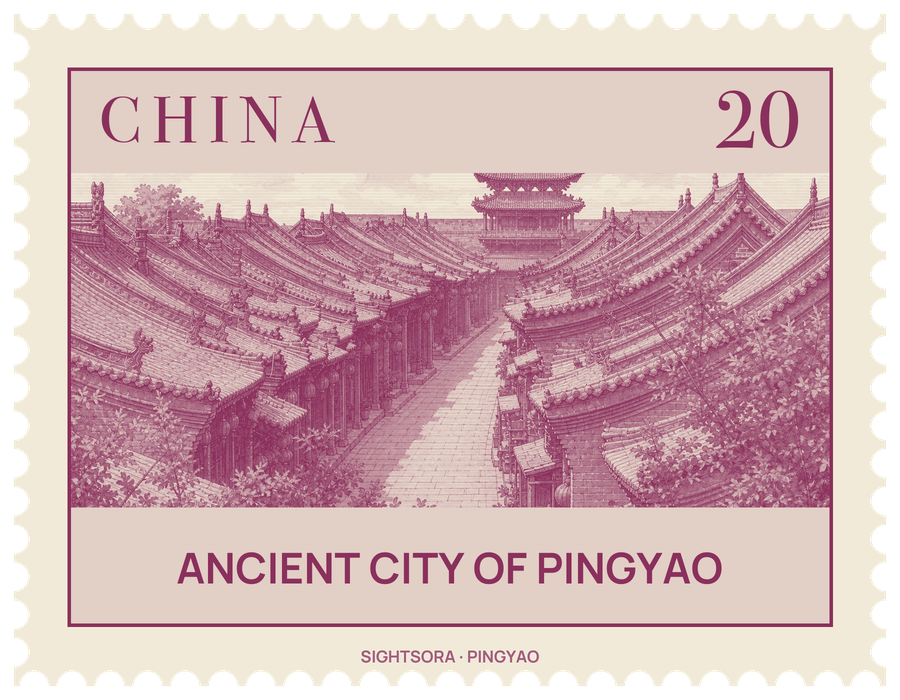
It lies just east of the Fen River, south of Taiyuan and 715 km south-west of Beijing. In 1997 the old town, along with the Zhenguo Temple and the Shuanglin Temple outside it, became a UNESCO World Heritage Site.
The walls are the first thing visitors meet. Raised in 1370, early in the Ming dynasty, they stand about 12 m high and run for 6,163 m around the town, with a moat 4 m wide just outside. Six barbican gates lead in, one in each of the north and south walls and two in each of the east and west walls; read as a head, a tail and four legs, they give Pingyao its nickname "Turtle City". Besides the four corner towers the walls carry 72 watchtowers and upwards of 3,000 battlements, a number said to match Confucius' disciples and students.
Inside, over a hundred streets and lanes are lined with close to 4,000 shops and houses from the 17th to the 19th centuries, and more than 20,000 people still live and work within the walls. Every kind of siheyuan courtyard plan can be found here. Many gates have stone lions, hitching posts and mounting stones outside, wooden hanging-flower gatehouses are carved with figures, flowers and birds, and the eaves often carry wood or brick carving or painted scenes from history and legend. In the middle of town rises the Market Tower, a 14th-century building.
The wealth behind these houses came from finance. From the 16th century Pingyao was the money centre of its region, and in the late 19th century of the whole Qing Empire, with more than 20 financial houses in the town. Its merchants pioneered paper remittances so that traders crossing the dangerous northern plains no longer had to carry gold and silver. The best known of these banks, Rishengchang, controlled close to half of the country's silver trade in the late Qing period and went bankrupt in 1914. The fortunes they made also built grand family compounds such as that of the Qiao family, a tea and tofu dynasty whose Grand Courtyard of 313 rooms near Pingyao is now a museum.
Pingyao keeps craft traditions of its own. Its tuiguang or "push-light" lacquerware gets its mirror shine from being rubbed by hand with the palm, not from varnish, over five to eight coats of raw lacquer laid over grounds of black, cinnabar red, purple-green or apricot yellow; a museum in the county is devoted to it. At the Qingxu Temple, 28 of the original 36 gauze-fronted cases of painted clay opera figures made in 1906 survive, each showing a high point from a named opera. Local dishes include Pingyao beef and wantuo, said to have been a favourite of the Empress Dowager Cixi.