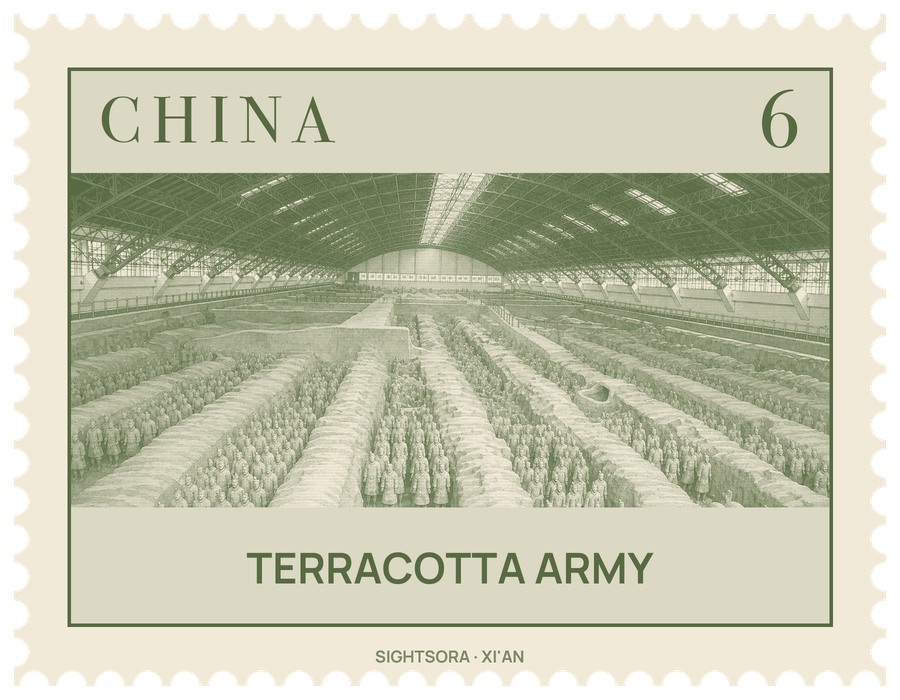
By estimates made in 2007, its three pits contain over 8,000 soldiers, 150 cavalry horses and 130 chariots drawn by 520 horses, most of them still unexcavated. The mausoleum was listed among China's first nationally protected heritage sites in 1961, and in 1987 UNESCO inscribed it together with the warrior pits as a World Heritage Site.
The army came to light on 29 March 1974, when Yang Zhifa, his five brothers and their neighbour Wang Puzhi were digging a well. Work on the emperor's tomb had begun in 246 BCE, soon after he became King of Qin at the age of 13; the historian Sima Qian wrote that 700,000 conscripted labourers worked on it and described a burial chamber with rivers of mercury beneath a ceiling of heavenly bodies, an account later given weight by high mercury levels found in the soil of the mound. The warriors are only one part of a necropolis that surveys have measured at roughly 98 square kilometres, laid out as a model of the emperor's palace compound, with offices, halls, stables and a park around the pyramid-shaped earthen mound at the foot of Mount Li.
Four main pits, about 7 metres deep, have been found, with the soldiers drawn up to face east, where the states the emperor had conquered lay. Pit 1, 230 metres long and 62 metres wide and covered today by a roofed hall of the museum, holds the bulk of the army, over 3,000 figures, in eleven parallel corridors that were once roofed with timber, reed mats and clay. Pit 2 holds cavalry, infantry and war chariots, Pit 3 is the command post with senior officers and a chariot, and Pit 4 is empty. Burnt rafters and fire-damaged figures point to the looting and burning recorded after the emperor's death, which brought the roof down; the figures on display have been pieced back together from fragments.
The soldiers stand roughly 1.75 to 2 metres tall, officers usually taller, and differ in uniform, armour and hairstyle according to rank: armoured and unarmoured infantry, cavalrymen in pillbox caps, charioteers, kneeling and standing archers and generals. Heads, limbs and bodies were made separately in workshops and joined, faces were shaped from perhaps ten basic moulds and then finished by hand in clay, so that no two look quite alike. They were once painted in reds, greens, blues, the pigment known as Han purple and pink for the faces, but most of the colour flakes away within minutes of exposure to Xi'an's dry air. Sculptors signed their names in the figures' armpits.
Most figures once carried real weapons; many were looted early on or have decayed, yet more than 40,000 bronze pieces have been recovered, mostly arrowheads in bundles of 100, along with swords, spears, crossbows and their triggers. Other pits around the mound have yielded bronze carriages, officials, stone armour, bronze cranes and ducks from an underground park, and a group of near-naked acrobat or dancer figures from Pit K9901 whose muscles and joints are modelled with unusual liveliness.