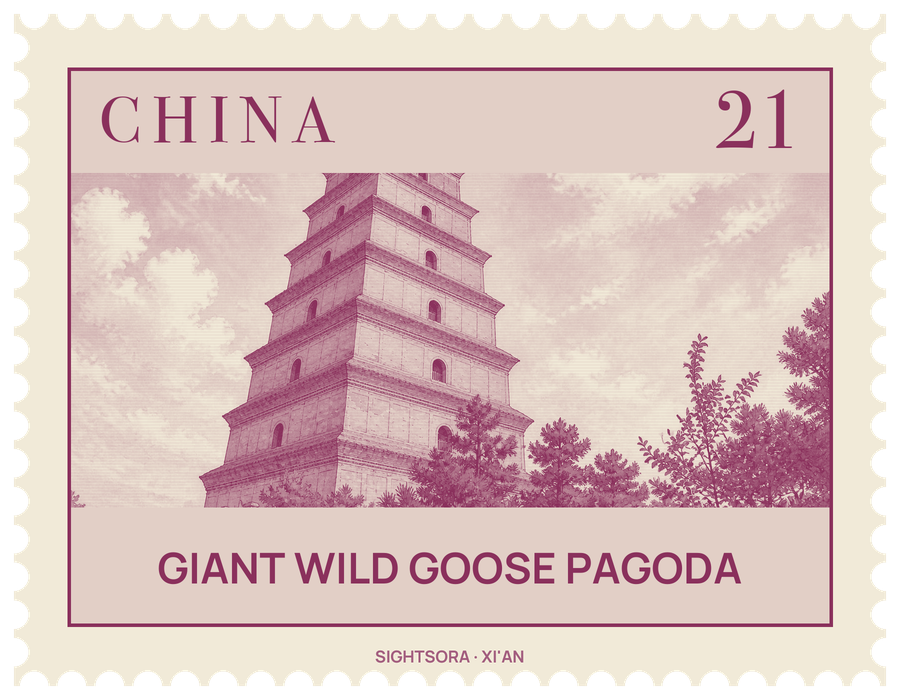
It was first raised in 652, when the city was Chang'an, capital of the Tang dynasty, by the monk and translator Xuanzang, who wanted a safe place for the hundreds of Sanskrit scriptures and Buddhist images he had carried back from India. It belongs to the UNESCO World Heritage listing of the Silk Roads along the Chang'an-Tianshan Corridor, alongside Xingjiao Temple and the city's Small Wild Goose Pagoda.
The tower visitors see is not Xuanzang's original. That first pagoda had five storeys of brick over an earth core and stood 60 metres tall, but weeds took root between its bricks and damaged it, and Empress Wu Zetian and her nobles paid for it to be pulled down and rebuilt with seven storeys. It was later raised to ten, damaged in war and rebuilt at seven again, and Ming builders wrapped the Tang structure in a new brick skin sixty centimetres thick. Today it reaches 64.1 metres including its base.
Its brick surfaces copy timber building, with pillars, balustrades, arches and dougong brackets at each floor, and the storeys narrow as they rise. Visitors climb 248 steps inside to rooms on every level that open through brick arches on all four sides, and the rooms are painted with frescoes of Xuanzang's journey west in search of the scriptures. On the ground floor, bluestone lintels over the four doorways are incised with Buddha figures; the western one shows Amitabha Buddha preaching.
Beside the south door stand two stone tablets in brick niches. One carries the preface Emperor Taizong wrote in 648 for Xuanzang's translations, the other Emperor Gaozong's commentary on that preface, both written out by the calligrapher Chu Suiliang and still clearly legible beneath carved dragons. In Tang times candidates who passed the imperial examinations wrote their names at the temple, and "inscription at the Wild Goose Pagoda" came to mean success in the exams.
From 1945 heavy pumping of groundwater made the pagoda lean faster, and by 1996 its tilt had passed one metre. Over 400 wells around it were then sealed, and from 1997 the tower began slowly righting itself. Its outline forms the main element of the Xi'an city emblem, and two large squares now frame it: the South Square in front of the temple, with a statue of Xuanzang and gardens, and the North Plaza, with a central water feature and the Tang Culture Theme Plaza.