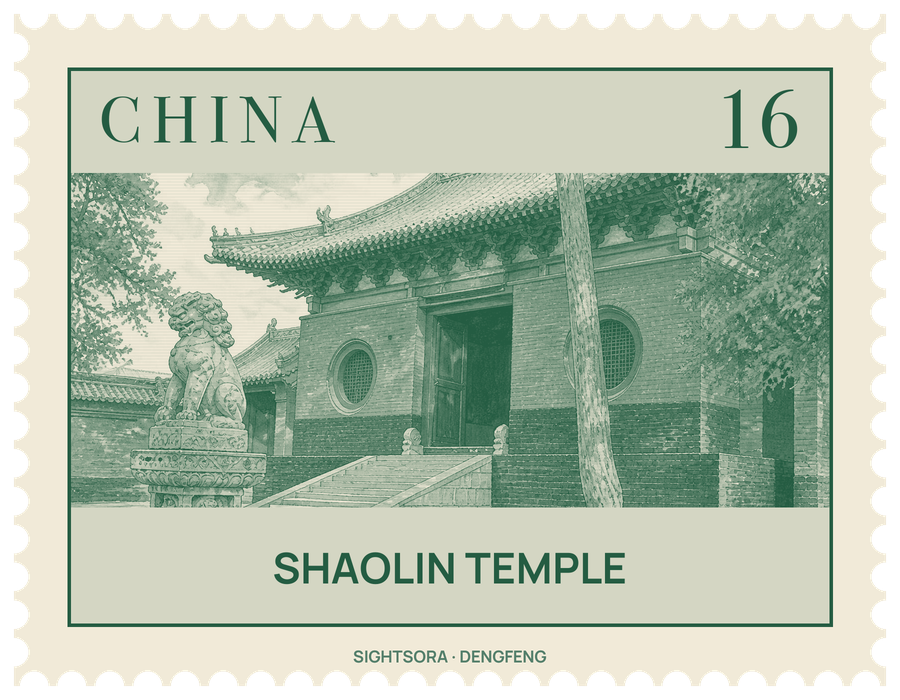
Its name refers to the old grove on Mount Shaoshi where it was built, in 495 under the Northern Wei dynasty, for the Indian monk Batuo, who made it a centre for translating Buddhist scripture. In 2010 the temple compound, its Pagoda Forest and the Chuzu Temple were inscribed on the UNESCO World Heritage List among the historic monuments around Dengfeng.
Tradition holds that the Indian monk Bodhidharma arrived in 527 and spent nine years meditating facing the wall of a cave on Wuru Peak, founding the Chan school; his disciple Huike is said to have cut off his own arm to prove his resolve. The monks' fighting reputation has firmer roots in history: at the start of the Tang dynasty thirteen of them helped the future Emperor Taizong defeat his rival Wang Shichong, and a stele erected in 728 records the land the temple received in return. In the Ming period Shaolin monks were sent to fight Japanese pirates on the coast, and the court rewarded the temple with new buildings and privileges.
The monastery has been destroyed and rebuilt many times. Rebels under Li Zicheng sacked it in 1641, and the Qing emperors restored it: Kangxi presented the name tablet now hung at the gate in 1704, in 1735 the court funded the rebuilding of the gate and of the Thousand Buddha's Hall, and Qianlong stayed overnight in the abbot's room in 1750. On 15 March 1928 the warlord Shi Yousan set the temple on fire, destroying halls, relics and 5,480 volumes of scripture, and the Cultural Revolution brought further damage. With no plans surviving, the architects who rebuilt it after the heritage law of 1982 questioned elders who had known the monastery before 1928.
Inside, the compound measures 160 by 360 meters, with seven main halls along the central axis, more halls around them, and steles and old ginkgo trees scattered through the yards; most halls now display Buddhist artefacts. Visitors pass through the Shanmen gate, rebuilt in 1735 under the gold-lettered Kangxi tablet, then the Forest of Steles and a corridor of 124 stone tablets reaching back to the Northern Qi. Further in are the Hall of the Four Heavenly Kings with its two armed guardians at the door, the Drum Tower, the Dharma Hall, the abbot's room with murals and a lineage chart of the Shaolin tradition, and the Pavilion of He Who Stands in Snow, also called the Hall of Damo.
About 300 meters west of the monastery lies the Pagoda Forest, a cemetery of 240 tomb pagodas in many sizes built for monks from the Tang to the Qing dynasties. Also part of the site are the Chuzu-an, the Hermitage of the First Patriarch, first built under the Song dynasty, and the cave of Damo on Wuru Peak, where the nine years of wall-gazing are said to have taken place. The temple still teaches kung fu as a system of forms that combine attack and defence, hard and soft, movement and stillness, alongside Chan meditation, traditional medicine and calligraphy.
Getting there
Luoyang and Zhengzhou are the usual starting points for the trip by bus or car. China National Highway 207 crosses the pass from the Luoyang side and runs past the scenic area, where a purpose-built North Gate complex serves arriving visitors and the Shaolin bus stop sits on the highway, here called East Ring Road, Dengfeng.