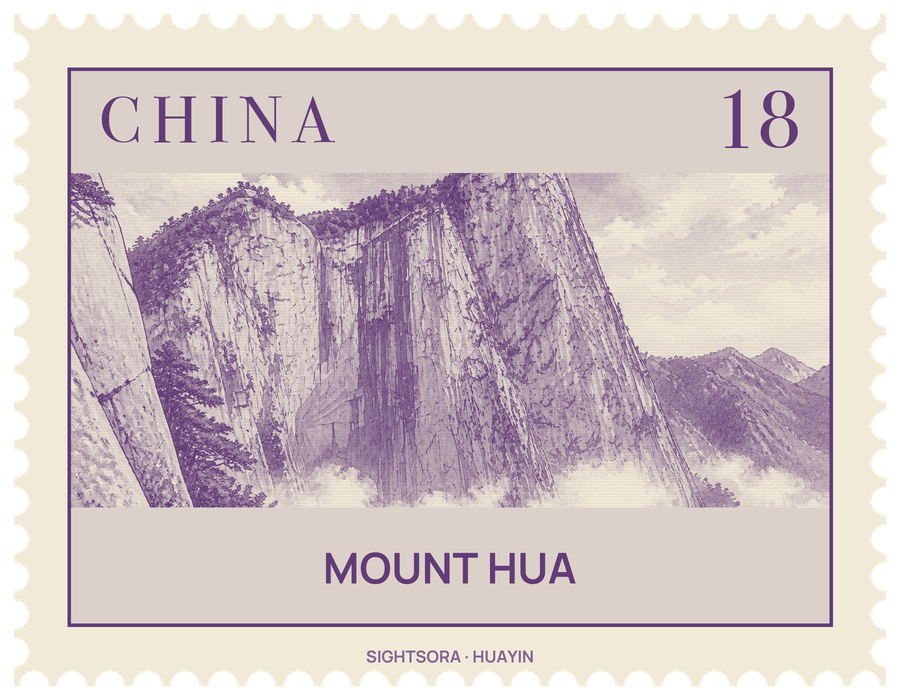
Among the Five Great Mountains of China it holds the western place, honoured with offerings as the Western Marchmount since the Han dynasty, and its steepness earned it the nickname "Number One Steepest Mountain Under Heaven". Five main peaks are recognised today; the South Peak is the highest, at 2,154.9 metres.
The mountain forms the eastern tip of the Qin Mountains, the range that splits Shaanxi, and China itself, into north and south. A Daoist temple called the Shrine of the Western Peak stood at its base as early as the 2nd century BC, and Daoists held that the god of the underworld lived on the mountain. Seekers of immortality came for its medicinal plants, and the hermit Chen Tuan spent his last years on the West Peak. Under the Tang dynasty the mountain lay halfway along the road between the capitals Chang'an and Luoyang, and Emperor Xuanzong made it the sacred mountain of the royal family.
Temples still mark the slopes. At the foot stands the Cloister of the Jade Spring, dedicated to Chen Tuan, and an old Daoist temple on the southernmost peak now serves as a tea house. Five kilometres north of the mountain, on Yuezhen Street, the Xiyue Temple honours Xiyue Dadi, the god of the mountain; it dates back to the reign of Emperor Wu of Han, and rulers of later dynasties came there to make sacrifices. Most of the mountain's temples were handed to the China Daoist Association in 1998.
Legend explains the shape of the peaks. The god Juling Shen is said to have cut the mountain free from its neighbours with one blow of his axe, opening a way for the Yellow River to reach the sea. On the West Peak a rock split cleanly into three, the Axe-splitting Rock, is tied to the story of Chenxiang, who broke open the mountain to free his mother, Huayue Sanniang, imprisoned beneath it for marrying a mortal.
The ascent begins with the North Peak, the lowest of the five at 1,614.9 metres, reached by three routes. The traditional path climbs 6 km through Hua Shan Gorge from Huashan village, while another follows the cable car up Huang Pu Gorge. From the North Peak a path climbs more than 300 m along Canglong Ling, the Dark Dragon Ridge, which was once the only way on to the other peaks; a second path now bypasses it. Narrow, exposed trails with long drops gave Huashan its reputation for danger, and deeper-cut steps, wider paths, railings and one-way sections have since made the climb safer.
Many Chinese climbers still set out after dark to reach the East Peak in time for sunrise, a habit from the days when it seemed safer not to see the drops and to avoid meeting people coming down on the narrowest ledges. The mountain also has many hotels for those who prefer to break the climb.