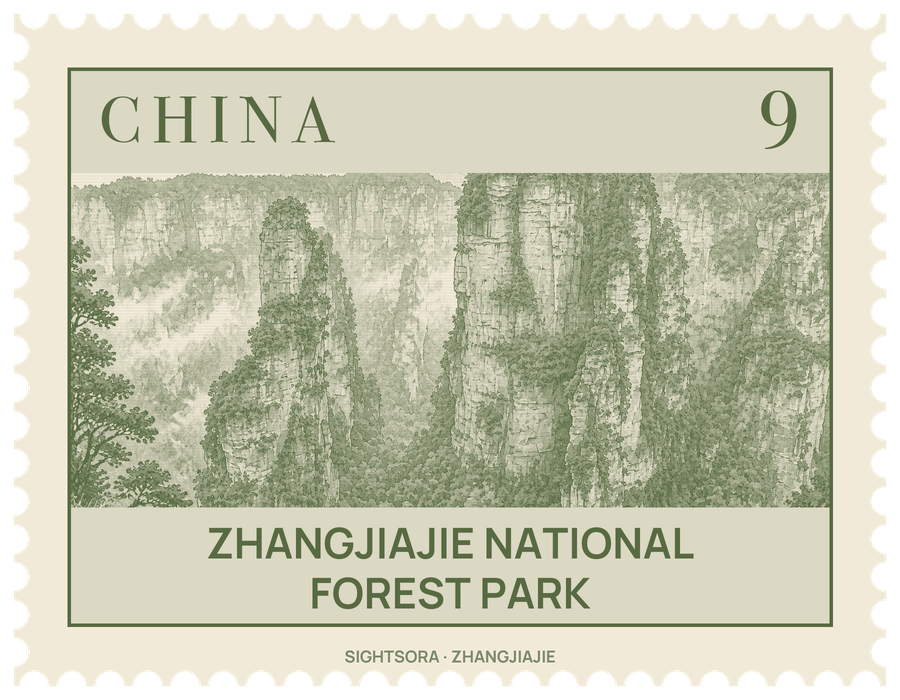
In 1982 it became China's first national forest park, covering 4,810 hectares, and it forms one part of the larger Wulingyuan Scenic Area, which UNESCO inscribed as a World Heritage Site in 1992. The surrounding sandstone peak forest was later declared a national geopark in 2001 and a UNESCO global geopark in 2004.
The pillars look like limestone karst, but the rock here is not limestone and was not dissolved by water. They were shaped by physical erosion over a long time: ice expanding in cracks during winter and the roots of the plants that cling to the rock prise them apart, and streams carry the loose material away. The air stays moist throughout the year, so the vegetation on and around the columns is very dense. Towers of rock like these appear in many old Chinese paintings.
One of the pillars, the Southern Sky Column, 1,080 metres high, was renamed "Avatar Hallelujah Mountain" in January 2010. The makers of the film Avatar said their floating mountains drew on peaks from around the world, above all Guilin, Huangshan and Zhangjiajie.
Several lifts carry visitors up to the high ground. The Bailong Elevator, whose name means "hundred dragons sky lift", opened in 2002; its three glass cabins, each holding up to 50 people, climb 326 metres in under two minutes. The park also has three cable cars, serving Tianzi Mountain, Yangjiajie and Huangshizhai, and a monorail runs up the Ten-Mile Gallery. Caves are scattered through the area as well.