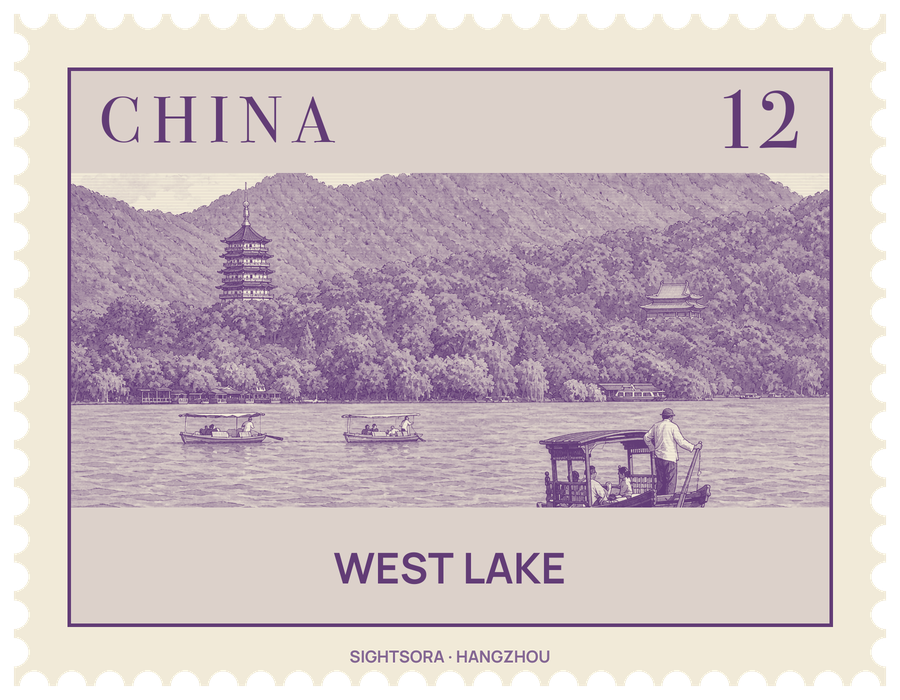
Gentle hills enclose it on three sides and the city lines the fourth; the Leifeng Pagoda on the south shore and the slender Baochu Pagoda on the north face each other across the water, and causeways and islands break the surface into several lakes. UNESCO inscribed it as a World Heritage Site in 2011, recognising its influence on garden design in China, Japan and Korea.
The lake began as a shallow bay that silted up into a lagoon, and only constant dredging has kept it from turning into marsh. Two of China's great poets left their names on it: Bai Juyi dredged it in 822 and built a causeway with the silt, and Su Shi did the same in 1089, raising the Su Causeway and placing three small stone pagodas in the water, possibly the origin of a much-loved view. Visitors have come since the Tang dynasty, and after the Song moved their capital to Hangzhou in 1129 sightseeing here became a business, with guides, set routes, decorated pleasure boats and a canon of named views. Marco Polo described the lake and its island pavilions, and it has appeared on Chinese banknotes and in the Chinese passport.
The layout is often summed up as a count: a hill, two pagodas, three islets, four causeways, five lakes. The hill is Gushan, the only natural island, joined to the north shore by Xiling Bridge and the Bai Causeway; its Qing imperial retreat later became Zhongshan Park, and the Wenlan Pavilion, an imperial library of 1784 rebuilt in 1880, became part of the Zhejiang Provincial Museum. Local lore calls the Broken Bridge, Gushan and the Long Bridge the Three Oddities, because none of them lives up to its name: the bridge is intact, the island is attached to the shore and the long bridge is short. The Su Causeway, with six bridges, crosses the whole lake between Huagang in the south and Quyuan in the north, with the inner lakes beyond it; further west, the Yanggong Causeway of 1508 also has six bridges.
Of the three islets built from dredged mud, Lesser Yingzhou is known for the small stone pagodas standing in the water around it, lit at the Mid-Autumn Festival to make the scene called Three Ponds Mirroring the Moon. The tiny Mid-Lake Pavilion is remembered through Zhang Dai's essay on watching snow there, and Ruan Gong Islet is kept as a nature reserve. The Leifeng Pagoda, first built in 975 and linked to the Legend of the White Snake, collapsed in 1924 and was rebuilt in 2002. The Ten Scenes of West Lake, a set of named views dating back to the Song, are each marked by a stele carrying the Qianlong Emperor's calligraphy, among them Spring Dawn at Su Causeway, Lingering Snow on Broken Bridge and Leifeng Pagoda in Evening Glow.
The hills west of the lake hold Lingyin Temple, whose roots go back to the 4th century, and Jingci Temple on Nanping Hill, along with Buddhist carvings on Feilaifeng Peak and in Yanxia Cave. By the lake stand the Tomb and Temple of Yue Fei, the general executed in 1142 whose remains were moved here after he was cleared, and the tomb of the poet Su Xiaoxiao near Xiling Bridge. The hills are also home to the Longjing Tea Plantation, where the green tea of the same name grows on terraces in a misty valley. In the city's cooking, lake cuisine draws on fish, shrimp and vegetables, with dishes such as West Lake Fish in Vinegar Gravy.