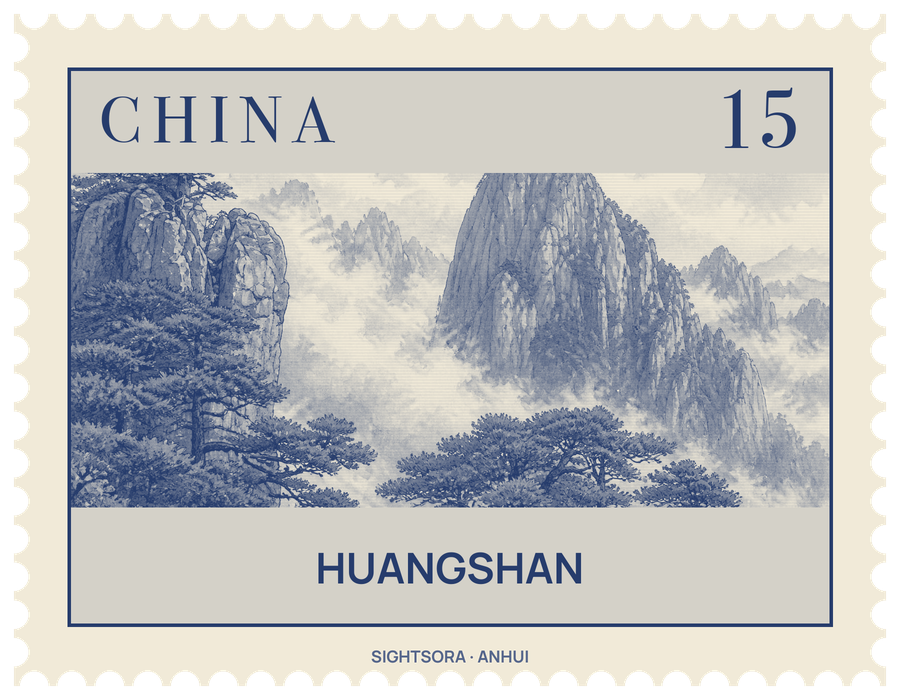
Its three highest and best-known peaks are Lotus Peak at 1,864 metres, Bright Peak at 1,860 metres and Celestial Peak at 1,829 metres. UNESCO listed it as a World Heritage Site in 1990, both for its scenery and as a refuge for rare and threatened species, and it became a UNESCO Global Geopark in 2004.
Under the Qin dynasty the range was called Yishan. An imperial decree renamed it in 747, generally taken as an honour to Huang Di, the Yellow Emperor; one legend has him ascending to Heaven from here, another has him refining pills of immortality on the slopes. After the change of name the once remote mountains drew far more visitors, and temples were built. Between the Tang and the end of the Qing, writers produced more than 20,000 poems about Huangshan, a school of painting took its name, and the poet Li Bai is often credited with first using the name. James Cameron listed it among the places that shaped the floating world of his 2009 film Avatar.
The rock took shape about 100 million years ago in the Mesozoic, when uplift drained an ancient sea, and glaciers carved it further in the Quaternary. Forest clothes the slopes as high as the 1,800-metre tree line, and alpine grassland takes over above it. The Huangshan pine is named after the range; many of these trees are over a hundred years old and have names of their own, such as the Ying Ke, or Welcoming-Guests, Pine, believed to have stood for over 1500 years, and the more twisted they are, the more they are admired. Many peaks and viewpoints carry names with stories attached: Shixin, roughly "start to believe", recalls a sceptic who came to doubt the mountain's reputation and was won over at once.
From the summits visitors often look down on the clouds, known as the Sea of Clouds, with viewpoints named after it as North Sea or South Sea. Sunrise is a central part of a stay, and a halo effect called Buddha's Light shows up on average only a couple of times a month. Hot springs, most of them at the foot of Purple Cloud Peak, stay at 42 °C through the year. The moist climate also suits tea, and the local green tea Mao feng is named for the fine down on the young leaf tips.
More than 50 kilometres of footpaths link at least 140 sections open to visitors, and stone steps cut into the mountainsides, possibly more than 60,000 of them, run across the range. Hotels and guest houses on the mountain let many walkers climb up, spend the night on a peak for the sunrise and come down by another route the next day. The facilities at the top are kept supplied by porters carrying loads slung from poles across their shoulders.
Getting there
Huangshan City, renamed from Tunxi in 1987, has rail and air links to Shanghai and can also be reached from Hangzhou and Wuhu. Buses run from the city to the foot of the mountain, where visitors either take a cable car or walk up to the summit.