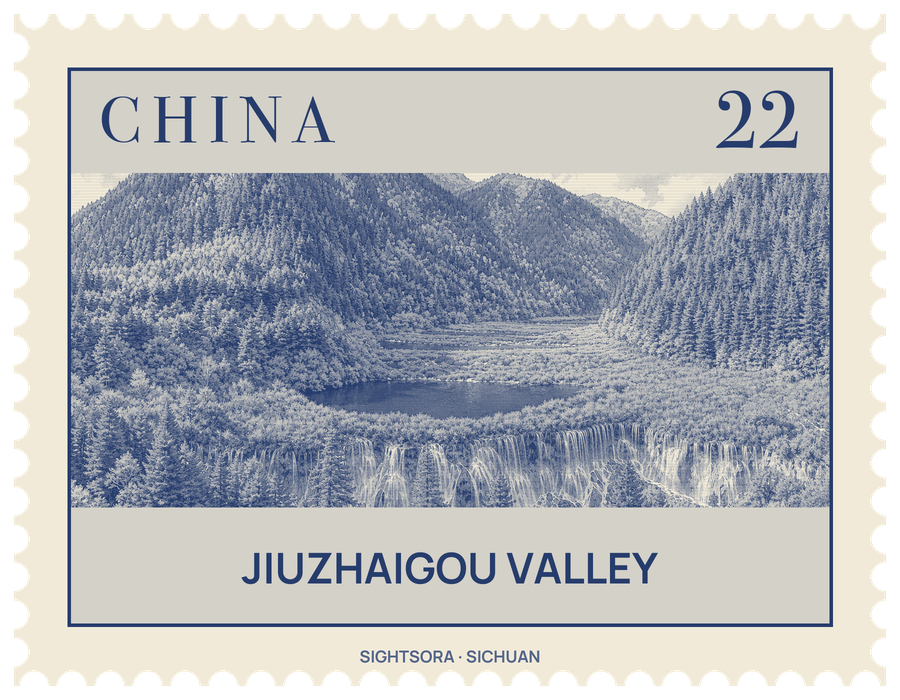
Its name means "Nine Settlement Valley", after the nine Tibetan villages along its length, seven of which are still lived in; Heye, Shuzheng and Zechawa lie beside the main paths and sell crafts and snacks. Logging was halted after a survey by the forestry scientist Wu Zhonglun in 1975, a nature reserve followed in 1980, and the valley opened to tourism in 1984. UNESCO inscribed it as a World Heritage Site in 1992.
The lakes are what draw people here: dozens of them in blue, green and turquoise, which local Tibetans call haizi, "son of the sea". Glaciers carved their basins, rockfalls dammed them, and calcium carbonate settling out of the water hardened the dams; the same tufa coats rocks, lake beds and sunken tree trunks, building up terraces and shoals. Where the water is rich in carbonate it is so clear that the bottom shows even at depth, and each lake's colour shifts with its depth, sediment and setting.
The park is shaped like a Y. Shuttle buses run on 55 km of roads up the three gullies, while wooden boardwalks and small pavilions follow the far side of the lakes, away from the traffic, and most visitors ride to the head of a gully and walk back downhill. Rize Valley, the south-western arm, holds the most sights: the Primeval Forest below the 500-metre blade of Sword Rock, Swan Lake, Arrow Bamboo Lake, where scenes of the 2002 film Hero were shot, Panda Lake spilling into the three-step Panda Waterfalls, Five Flower Lake with ancient fallen trunks across its bed, and Pearl Shoal, a wide slope of flowing water that drops 28 m over the Pearl Waterfalls.
Zechawa Valley, the south-eastern arm, climbs higher, to Long Lake at 3150 m. The largest and deepest lake in Jiuzhaigou, it curves for 7.5 km, reaches 103 m deep and is said in local folklore to hide a monster. Below it lies the tiny but vividly coloured Five-Color Pond, where the goddess Semo is said to have washed her hair, and a chain of Seasonal Lakes that fill and empty through the year.
Shuzheng Valley, the main northern arm, runs 14.5 km down to the valley mouth. Near the junction are the Nuorilang Falls, whose natural dam was damaged in the magnitude 7.0 earthquake of August 2017; further down come the stepped Nuorilang and Shuzheng lakes, Sleeping Dragon Lake with a pale dyke on its bed shaped like a sleeping dragon, and Reed Lake, a marsh cut by a turquoise stream called the Jade Ribbon. The forests shelter small, isolated populations of giant pandas and golden snub-nosed monkeys and about 140 bird species.
Getting there
The nearest railway stop is Huanglongjiuzhai station on the Sichuan-Qinghai Railway, in service since 30 August 2024 and about 90 minutes from the valley by car. Jiuzhai Huanglong Airport, set at 3,448 metres on a mountainside in Songpan County, has flights from Chengdu and Chongqing, and a bus from there takes about 90 minutes. By road, the route from Chengdu follows the Min River canyon.