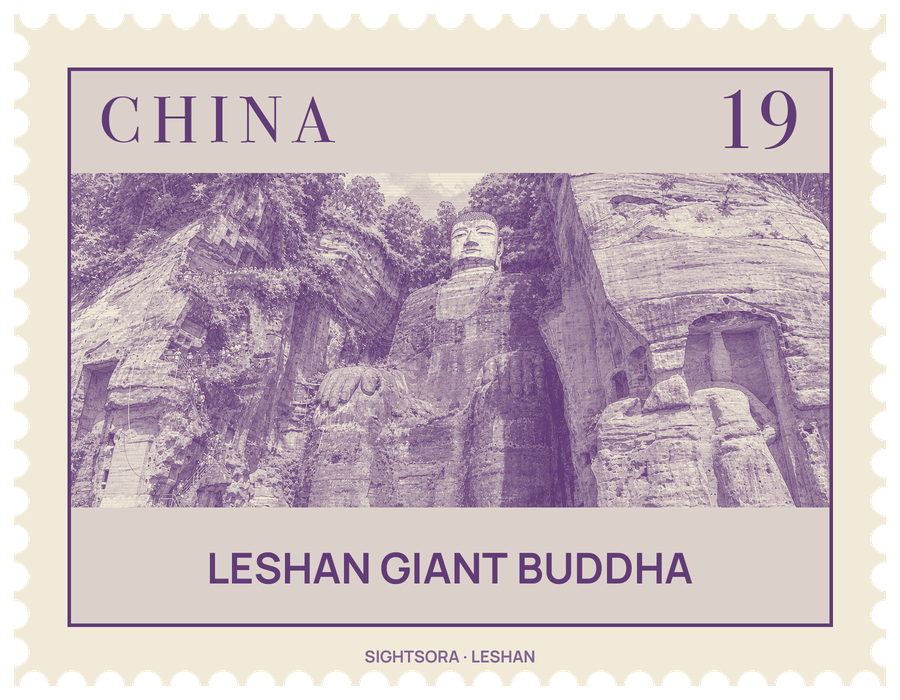
The figure rests its hands on its knees and looks across the water towards Mount Emei, with the rivers running past its feet. Together with the Mount Emei Scenic Area, it has been a UNESCO World Heritage Site since 1996.
The carving was a Tang dynasty project that took the better part of a century. It was begun by the monk Hai Tong, who hoped the Maitreya Buddha would tame the violent currents that wrecked boats on the river; when funds ran short, he is said to have put out his own eyes to prove his sincerity. At his death only the head and shoulders were done, and his disciples carried on in stages with backing from local officials until the statue was finished. So much stone fell into the river that the currents really did change, and the water became safer for shipping.
Its proportions follow the traditional rules for Buddha images, in the calm style of Tang statues. The hair is made of 1,021 spiral curls, the ears are 7 metres long and were made of wood coated with clay, the nose and eyebrows are each 5.6 metres long, and the instep is wide enough for about a hundred people to stand on, while a seated person fits on the smallest toenail. Gutters and channels hidden in the hair, collar and chest, with holes behind the ears, were built in from the start to carry rainwater away and still work.
A thirteen-storey wooden hall once sheltered the statue from sun and rain, until the Mongols sacked it in the fighting as the Yuan dynasty fell, leaving the Buddha in the open. A local saying calls the mountain a Buddha and the Buddha a mountain, because seen from the river the range looks like a sleeping Buddha with the statue at its heart. Weathering, plants and air pollution have worn the stone, and repairs funded by the World Bank in 2002 restored the head and chest, strengthened the cliff and mended the rock at the feet.
Visitors can see the statue in two ways. A steep, narrow plank path gives a changing close view of the body from one angle after another, while sightseeing boats on the river show the whole figure at once. Dozens of footpaths cross the mountain around it. The Wuyou Temple lies more than 4 kilometres away, and the Mahao Cliff Tombs within the scenic area date from the Han dynasty.
Getting there
From Leshan town, local bus 13 runs to the Giant Buddha.