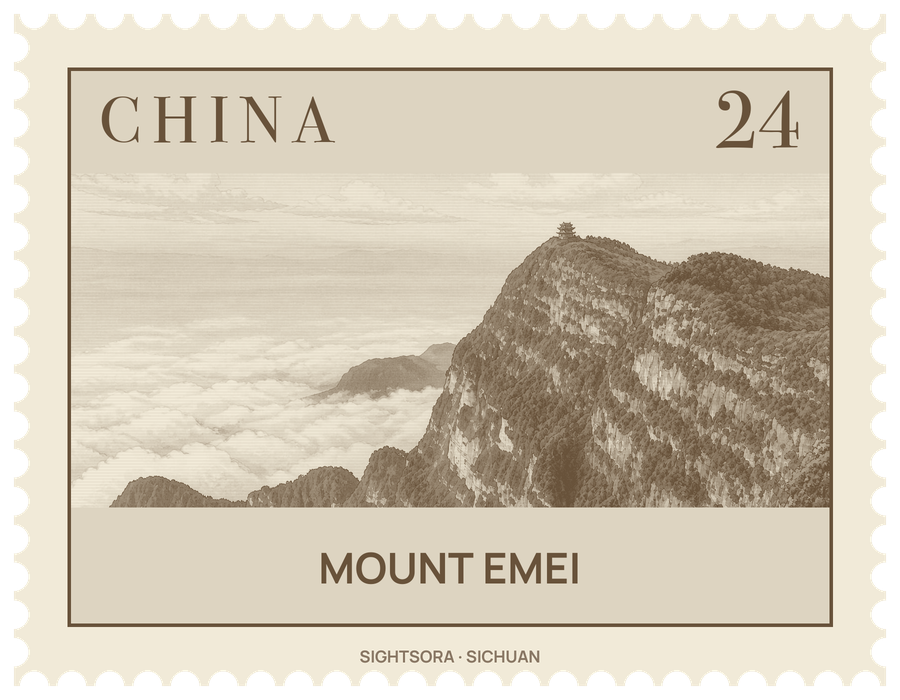
Buddhists regard it as the place of enlightenment of the Bodhisattva Puxian (Samantabhadra), and pilgrims climb it regularly. The name means "towering eyebrows", and the mountain has been a UNESCO World Heritage Site since 1996.
Seventy-six monasteries from the Ming and Qing dynasties stand on the mountain, most of them high up near the top. Rather than follow a fixed plan, their builders fitted them to the ground: the halls of Baoguosi step up a series of terraces, the buildings of Leiyinsi stand on stilts, and Qingyinge fills an irregular strip squeezed between two streams, the White Dragon River and the Black Dragon River. Records from the 16th and 17th centuries also mention martial arts being practised in the monasteries here.
The winding footpath up the mountain is 50 km long and takes several days on foot. Cable cars shorten the climb to Jinding, the Golden Summit at 3,077 metres, where two temples stand about an hour's walk below the true peak. A large statue of Samantabhadra crowns the summit area, approached by steps lined with elephant statues.
The forests change with height, from subtropical evergreen woods low down, with oaks, laurels and Schima, through mixed broadleaf and conifer forest to subalpine shrubland above 2800 metres. About 100 plant species are found only in this area, among them the fir Abies fabri and Magnolia omeiensis. Some 2,300 animal species have been recorded, including the red panda, the Asian black bear and the Chinese giant salamander, along with rare birds such as the Emei Shan liocichla.
Tibetan macaques are the animals most visitors meet, often snatching food from people on the paths. If food is held out near them, they may grab at clothing or bite when provoked.