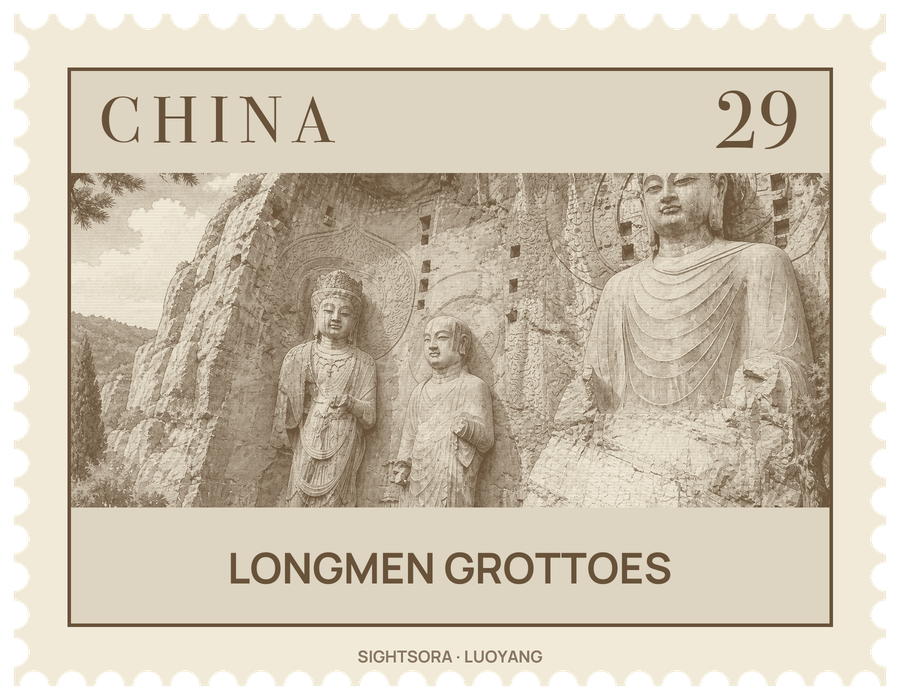
Carving began in 493 under the Northern Wei, after Emperor Xiaowen moved his capital to Luoyang, and went on into the Northern Song; about 30% of the caves are Northern Wei work and 60% Tang. Two hills, Longmenshan on the west and Xiangshan on the east, pinch the river like a pair of gate towers, which gave the place its name, "Dragon's Gate". UNESCO added the grottoes to the World Heritage List in 2000.
Most of the carving is on the western bank, where the caves are numbered from north to south and entered from the northern end; the fewer caves on the eastern bank, all from the Tang dynasty, housed the monks. The figures range from statues of 17 metres down to images an inch high, among nearly 2,500 inscriptions and steles and about 60 pagodas. Walking along the cliff, visitors can follow the change in style, from the slim, elongated figures of the Northern Wei to the fuller, more natural Tang sculpture, which brings in women and court figures.
The Guyang Cave, the oldest at Longmen, was ordered by Emperor Xiaowen; its three great images centre on Sakyamuni Buddha, and the walls carry hundreds of inscriptions in fine Northern Wei calligraphy, in which artists recorded their names, dates and reasons for carving. Emperor Xuanwu then cut the three Binyang Caves for his parents. In the Middle Binyang Cave five large figures fill the main wall beneath a ceiling carved as a lotus; two reliefs of imperial processions were removed in the 1930s, and the emperor's procession ended up in New York's Metropolitan Museum of Art. The South Binyang Cave was carved in 641 by Li Tai, son of Emperor Taizong, in memory of his mother.
The high point of the site is the Fengxian cave, carved under Emperor Gaozong and Empress Wu Zetian, who is said to have paid towards it out of her own cosmetics allowance. Its open shrine measures 39 by 35 metres, and on the back wall the Vairocana Buddha rises 17.14 metres, with ears 2 metres long and a calm, rounded face often thought to be modelled on the empress herself. The disciples Kasyapa and Ananda, crowned Bodhisattvas, heavenly kings and temple guardians stand on either side.
Smaller caves reward a closer look. The Cave of Ten Thousand Buddhas, made in 680, holds 15,000 tiny Buddhas in niches, the smallest only 2 centimetres high; the Medical Prescription Cave has 140 remedies carved at its entrance, for complaints from colds to madness; and the Lotus Flower Cave has a large lotus in high relief on its ceiling. Across a bridge on the eastern bank stand the Xiangshan Temple, the Bai Garden temple on Pipa peak among pines and cypresses, and the hilltop tomb of the Tang poet Bai Juyi, who spent his last years in Luoyang.