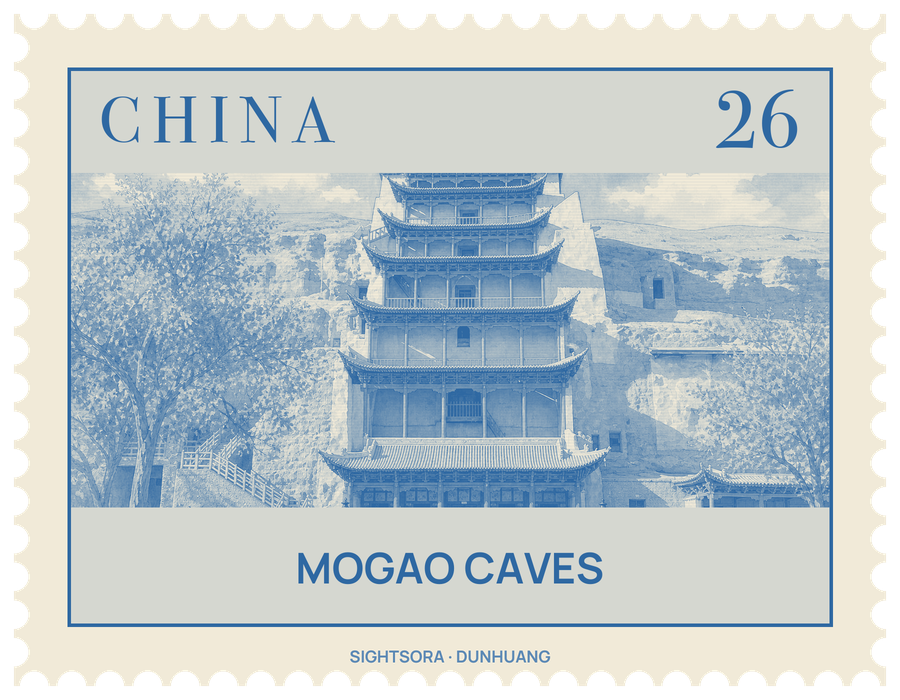
Dunhuang was a Silk Road gateway where traders, pilgrims and religions met, and from the fourth century until the 14th monks dug cave after cave here with money from donors, covering their walls and ceilings with paintings. UNESCO listed the caves as a World Heritage Site in 1987.
Tradition says a monk named Le Zun, or Yuezun, saw a vision of a thousand Buddhas shining in golden light at the site and dug the first cave. Patrons ranged from clergy, local rulers and emperors to merchants, officers and women's groups, and some leading clans built family caves. Under the Tang their number passed a thousand. Of the 735 that survive, the 487 in the southern section of the cliff are decorated shrines, while 248 plainer caves to the north served the monks as living quarters, meditation cells and burial places.
The paintings cover a span of about a thousand years. Early work shows strong Indian and Central Asian influence, then a local Dunhuang style develops from the Northern Wei onwards. Whole walls are filled with rows of identical small Buddhas painted with stencils, flying apsaras drift across ceilings, and jataka tales of the Buddha's lives are told in long scenes; under the Tang, great paradise scenes of the Pure Land appear, such as the Western Paradise in Cave 220. Many faces now look heavily outlined because the lead-based pigments used for shading have darkened.
Around 2,400 painted clay sculptures survive, built up over wooden frames padded with reed. The two giant seated Maitreya Buddhas have stone cores: the larger, 35.5 metres high in Cave 96, was made in 695 after Empress Wu Zetian ordered giant statues built across the country, and it sits inside the nine-storey wooden building that is the most prominent structure on the cliff. Repairs have changed much of it except the head, while the smaller one, 27 metres tall, keeps most of its original form. In Cave 158 a reclining Buddha 15.6 metres long fills the length of the hall, with mourners behind it.
Cave 17, the Library Cave, was walled up early in the 11th century and found on 25 June 1900 by the Taoist abbot Wang Yuanlu while clearing sand. Inside lay tens of thousands of documents from the fifth to the early eleventh century, in Chinese, Tibetan, Sanskrit, Sogdian, Khotanese and other languages, Buddhist texts alongside Confucian, Taoist and Christian works, together with silk paintings, banners and a printed Diamond Sutra dated 868. Aurel Stein, Paul Pelliot and Japanese and Russian expeditions carried much of it away, and the largest collections are now in Beijing, London, Paris and Berlin. The statue of the monk Hongbian, for whom the cave was first made as a memorial, has been put back in its place.