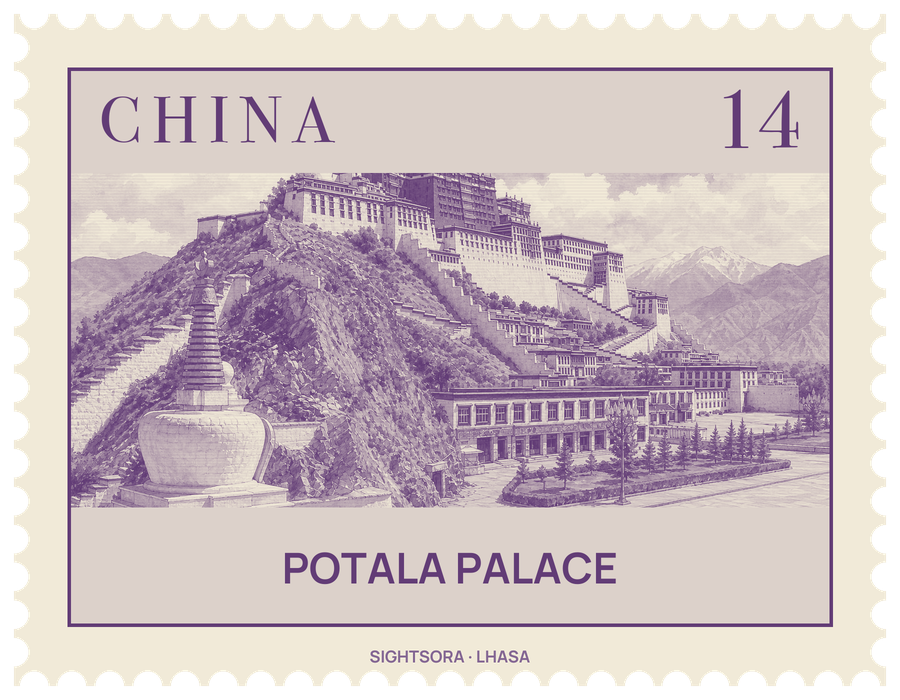
Built in the dzong style, it stretches 400 metres from east to west and 350 metres from north to south, and its thirteen storeys rise 119 metres above the hill and more than 300 metres above the valley floor. From 1649 until 1959 it was the residence of the Dalai Lamas, who used it as their winter palace, and it has since become a museum. It was inscribed on the UNESCO World Heritage List in 1994.
The name comes from Mount Potalaka, held in Buddhist tradition to be the home of the bodhisattva of compassion, Avalokiteśvara, also called Chenrezi. The 5th Dalai Lama, Ngawang Lozang Gyatso, began the present building in 1645 on the advice of Konchog Chophel, who judged the site well placed for a seat of government because it lay between old Lhasa and the two great monasteries of Drepung and Sera. It stands where an earlier palace attributed to Songtsen Gampo had been, traditionally dated to 637; two chapels in the northwest corner, the Phakpa Lhakhang and the Chogyel Drupuk, a cave identified as Songtsen Gampo's place of meditation, preserve parts of it.
The building has two main parts. The Dalai Lama's government took up residence in the Potrang Karpo, or White Palace, in 1649. The crimson Potrang Marpo, the Red Palace at the centre, was added between 1690 and 1694 and holds the principal halls and chapels and the shrines of past Dalai Lamas; its roofs end in gilded canopies. The outer shell went up in three years, but the interior and its furnishings took 45 years. The complex counts over 1,000 rooms, about 10,000 shrines and roughly 200,000 statues; among its treasures are the Kalachakra Mandala of the 1690s and the Yamantaka Mandala of 1751, as well as the former quarters of the Dalai Lama.
The walls lean inwards as they rise, with rows of windows in their upper parts and flat roofs at many levels. They average 3 metres thick and reach 5 metres at the base, and copper was poured into the foundations to protect the building against earthquakes. At the southern foot of the rock lies a large walled enclosure with gates, from which flights of stairs climb towards the summit. During the Sertreng Festival two huge joined thangkas showing Tara and Sakyamuni were once hung down the white lower frontage on the south side.
The palace was damaged by shelling during the 1959 Tibetan uprising, and escaped harm in the Cultural Revolution in 1966 thanks to the personal intervention of Premier Zhou Enlai. It was restored between 1989 and 1994 and again from 2002. Concerned about modern buildings going up around it, UNESCO raised the issue with the Chinese government, which responded with a rule against any structure in the area taller than 21 metres.