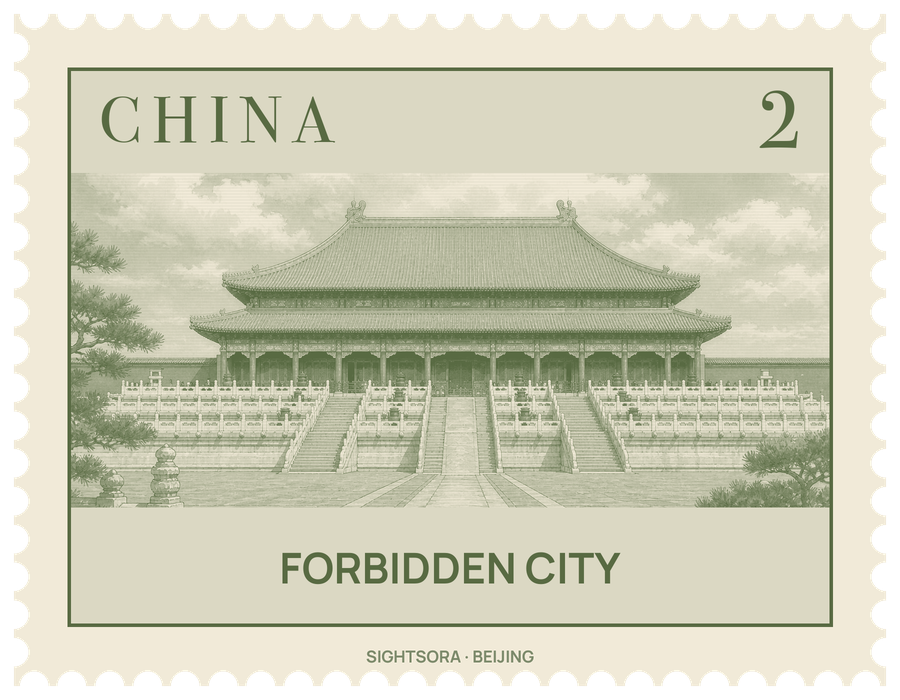
Twenty-four emperors made it their home, and it stayed the seat of power from 1420 until 1912; its 980 surviving buildings, roofed almost entirely in imperial yellow tiles, spread over 72 hectares. Since 1925 it has been the Palace Museum, whose collection grew from the treasures the two dynasties gathered, and UNESCO inscribed it as a World Heritage Site in 1987.
The Chinese name Zijincheng joins zi, purple, for the North Star that was the heavenly home of the Jade Emperor, with jin, prohibition: the palace was the earthly counterpart of that celestial court, closed to everyone but the emperor, his family and their servants. The Yongle Emperor began it in 1406 after moving the capital from Nanjing, and the work took 14 years and more than a million labourers, using whole logs of precious nanmu wood from the southwest, marble from quarries near Beijing and "golden bricks" baked in Suzhou for the floors. Rebels under Li Zicheng set parts of it on fire in 1644 before the Qing took over, Anglo-French forces occupied it in 1860, and the last emperor, Puyi, stayed on in the Inner Court after abdicating in 1912 until he was expelled in 1924. Part of the collection was later shipped to Taiwan, where it formed the heart of Taipei's National Palace Museum.
Visitors enter from the south through the Meridian Gate, whose two projecting wings enclose three sides of a square, into a courtyard where five bridges cross the curving Inner Golden Water River. Beyond the Gate of Supreme Harmony, three halls stand on a three-tiered white marble terrace: the Hall of Supreme Harmony, rising about 30 metres, where Qing emperors were enthroned and married; the smaller, square Hall of Central Harmony, where the emperor prepared for ceremonies; and the Hall of Preserving Harmony, which hosted the last stage of the Imperial Examination. Behind the last hall, the carved ramp of the Imperial Way is cut from a single stone 16.57 metres long, weighing some 200 tons. Only the emperor could use this central path, with the exception of the empress on her wedding day and the successful examination candidates.
North of a cross courtyard lies the Inner Court, the imperial family's home. Its three main halls repeat the pattern on a smaller scale: the Palace of Heavenly Purity for the emperor, the Palace of Earthly Tranquility for the empress, and between them the Hall of Union, which keeps the 25 Imperial Seals of the Qing. Behind them is the compact Imperial Garden, which ends at the northern gate. To the west, the Hall of Mental Cultivation became the emperor's real residence and office from the Yongzheng reign, and Cixi held court from its eastern room. On either side stand the Six Western and Six Eastern Palaces of the imperial consorts, and in the northeast the Qianlong Emperor built the Palace of Tranquil Longevity for his retirement, marked by a glazed Nine Dragons Screen.
Symbolism runs through the design. Yellow belonged to the emperor, but black tiles cover the Pavilion of Literary Profundity, a library, linked with water and protection from fire, and the crown prince's residences green ones for growth. The main halls are grouped in threes, echoing the trigram for Heaven, while the Inner Court residences come in sixes for Earth. Every gate carries nine rows of nine golden door nails, except the East Glorious Gate with eight. At the corners of the wall, towers with 72 roof ridges reproduce famous pavilions as they appear in Song paintings. The museum's holdings include around 340,000 ceramics, close to 50,000 paintings, some 30,000 jades and more than 1,000 mechanical clocks and watches from China and abroad.
The palace still anchors the city plan: its central axis is Beijing's axis, running south through the Tiananmen Gate to Tiananmen Square and north through Jingshan Park, an artificial hill made from the soil dug for the moat, towards the Drum and Bell Towers. Beihai Park lies to the northwest, and Zhongshan Park and the Imperial Ancestral Temple lie to the south.