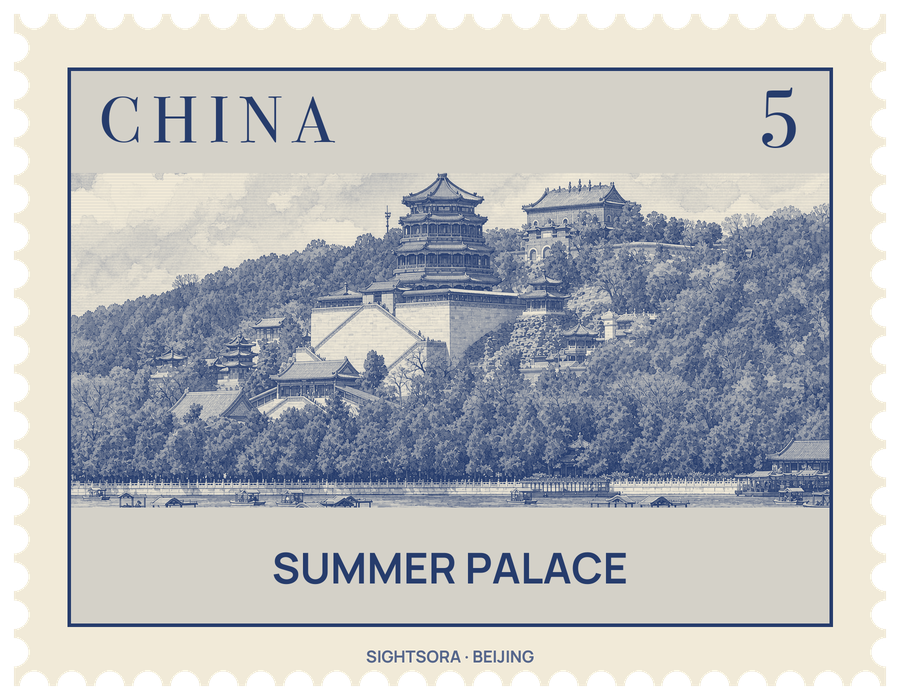
The grounds cover 2.9 square kilometres, three-quarters of it water, and hold more than 3,000 old buildings with a collection of over 40,000 historical relics. UNESCO placed it on the World Heritage List in 1998, praising the way its hills and water are combined with built features into a single composed landscape.
Emperors used the site long before the Qing: the Jin built a palace in the nearby hills from 1153, and around 1271 the Yuan engineer Guo Shoujing channelled spring water into the lake to secure the palace's supply. The garden as it is today began around 1749, when the Qianlong Emperor set out to mark his mother's 60th birthday. He had the lake enlarged and named it Kunming Lake, and the earth dug out was piled onto Jar Hill, renamed Longevity Hill. Finished in 1764 as the Gardens of Clear Ripples, it was laid out after a legend of three divine mountains in the eastern sea, represented by islands in the lake, while the lake itself followed the West Lake in Hangzhou.
British and French troops sacked and burned it, along with the nearby Old Summer Palace, in 1860. From 1884 Empress Dowager Cixi had it rebuilt and enlarged for her own 60th birthday, concentrating on the front of Longevity Hill and the lake dams, and in 1888 it received its present name. The Eight-Nation Alliance damaged it again in 1900 and it was restored two years later. In 1924 the Beijing government took it over and turned it into a public park.
Most of the main buildings stand on the front of Longevity Hill, about 60 metres high. The Long Corridor runs 728 metres along the lakeshore, its paintings showing well-known Chinese landscapes as well as episodes from myths, folk tales and the Four Great Classical Novels. Behind it the Hall of Dispelling Clouds, rebuilt in 1892, is where Cixi received guests and celebrated her birthdays, and the Sea of Wisdom on the summit, built of coloured glass, holds over 1,000 Buddhist statues. Down at the water's edge, the Stone Boat is a 36-metre marble replacement for a wooden boat burned in 1860, fitted with Western-style paddle wheels. The Hall of Jade Billows, where Cixi once kept the Guangxu Emperor confined, the Hall of Joy and Longevity, her living quarters, and the three-storey Great Opera Hall in Dehe Garden complete the front hill.
The quieter back hill has Suzhou Street, a shopping street the Qianlong Emperor ordered in 1762 in imitation of Shantang Street in Suzhou, destroyed in 1860 and restored in 1988; the Four Great Regions, modelled on Samye Monastery in Tibet; and the Garden of Harmonious Pleasures in the northeast corner, copied from Jichang Garden in Wuxi. Across the lake, the 17-Arch Bridge, 150 metres long and 8 metres wide, leads to Nanhu Island with its Dragon King Temple. The eastern shore has the Bronze Ox of 1755 and the gate-like Wenchang Tower, with a gallery of artefacts from the palace, while the West Dam, lined with bridges such as the Jade Belt Bridge, divides the lake in two.
Getting there
Beigongmen station on Beijing Subway Line 4 is close to the North Gate, and Summer Palace West Gate station on the Xijiao line serves the West Gate.