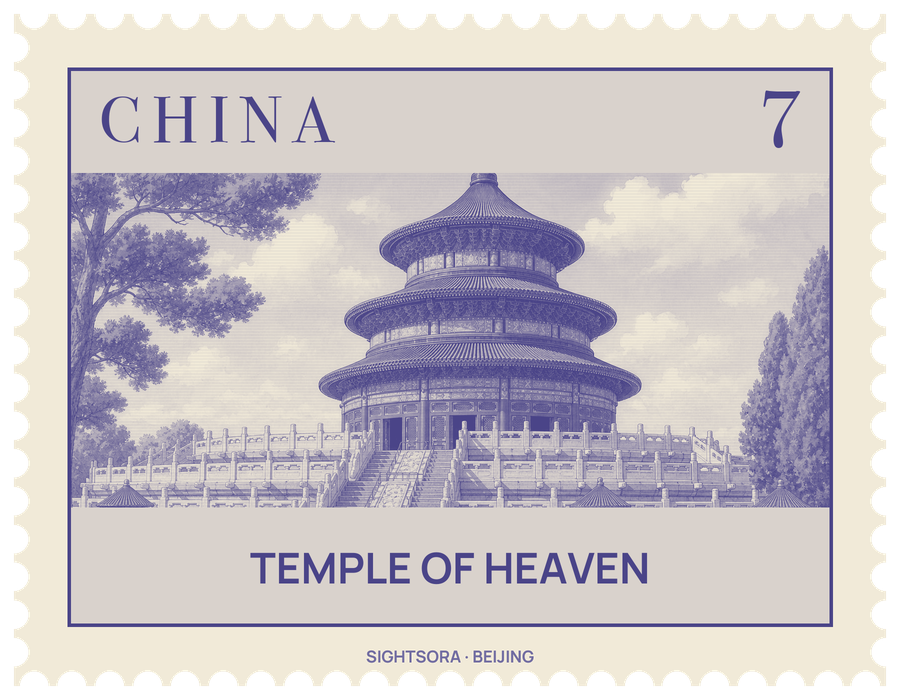
Its round, blue-roofed Hall of Prayer for Good Harvests is the building most people come to see. UNESCO added it to the World Heritage List in 1998, recognising how its symbolic plan shaped architecture and town planning across the Far East for centuries.
The Yongle Emperor, who also built the Forbidden City, founded the complex in 1420. In 1534, under the Jiajing Emperor, the old Altar of Heaven and Earth took the name Temple of Heaven, and Jiajing added separate temples to the Sun, the Earth and the Moon elsewhere in the city. The layout seen today had largely taken shape by 1749 after rebuilding under the Qing. Foreign armies occupied it twice, during the Second Opium War and again in 1900, when the Eight-Nation Alliance used it as a headquarters for a year. After the fall of the Qing several halls collapsed through neglect, and in 1914 Yuan Shikai staged a Ming-style prayer here as part of his bid to become emperor. It opened to the public as a park in 1918.
The emperor was regarded as the Son of Heaven, ruling on Earth in Heaven's name, so these rites mattered greatly. Twice a year he and his court left the Forbidden City in procession, dressed in special robes and keeping off meat, and camped inside the complex; ordinary people were not permitted to watch. A flawless ceremony was essential, since even a small slip was taken as a bad sign for the whole country in the year ahead.
The whole design plays on the old idea of a round Heaven and a square Earth. The outer wall is semicircular and taller at its northern end and rectangular and lower at the south. The Hall of Prayer and the Circular Mound Altar each pair a circular structure with a square yard around it. Nine, the emperor's number, governs the Circular Mound Altar: a central round slab is ringed by nine slabs, then 18, and so on through nine rings. In the Hall of Prayer, four central dragon pillars stand for the seasons, a ring of twelve for the months and an outer twelve for the two-hour divisions of the traditional day, and every building wears dark blue tiles for Heaven. East of the hall, the Seven-Star Stone Group stands for the seven peaks of Taishan, an ancient place of Heaven worship.
Much of the surrounding park is everyday public space, with playgrounds and areas for exercise and games used by local adults and by grandparents with children. In the mornings especially, open spaces and side buildings fill with choirs, dances and other performances.
Getting there
All four main gates of the park can be reached by public transport. Beijing Subway Line 5 stops at Temple of Heaven East Gate station, by the East Gate on Tiantan East Road, and Line 8 serves Tianqiao station near the West Gate on Tianqiao South Street. City buses also stop at every gate, among them routes 6 and 34 at the North Gate on Tiantan Road and routes 53 and 122 at the South Gate on Yongdingmen East Street.