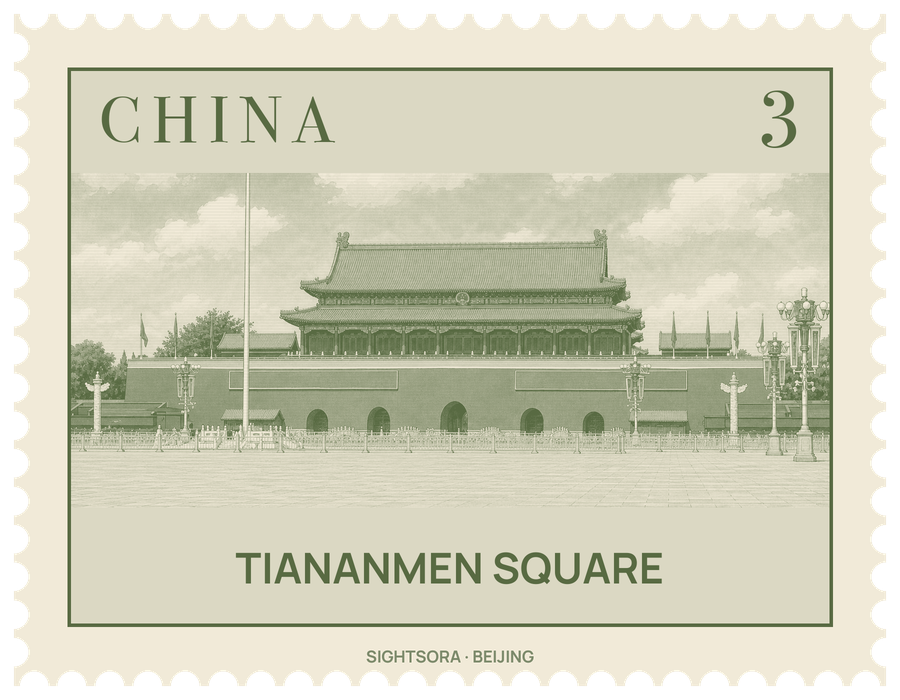
Around and within it stand the Great Hall of the People, the Chairman Mao Memorial Hall, the National Museum of China and the Monument to the People's Heroes. In 2024 they were inscribed as part of the Beijing Central Axis World Heritage Site.
The square sits between two great old gates: the Tiananmen to the north, built in 1417 under the Ming in the wall of the Imperial City, and the Zhengyangmen, also called Qianmen, to the south. The Great Hall of the People lines the west side and the National Museum of China, devoted to Chinese history before 1919, the east. In the middle rise the 38-metre Monument to the People's Heroes and, behind it on the north–south axis, the Mausoleum of Mao Zedong. At the northern end stands the national flagpole, where the flag is raised at sunrise and lowered at sunset each day.
The square was first laid out in 1651. In imperial times a purely ceremonial gate with three arches, known in turn as the Great Ming Gate, the Great Qing Gate and the Gate of China, stood near its centre; it stayed closed except when the emperor passed, and ordinary traffic was sent round through side gates, while a busy market grew up in the fenced area to its south. British and French troops camped by the gate when they occupied Beijing in 1860, and the Legation Quarter of foreign missions grew up just to the east.
The modern square is largely a creation of the 1950s. The Gate of China was pulled down in 1954, and in an 11-month project from November 1958 the square was expanded to four times its former size, with many homes and other buildings cleared away. The Great Hall of the People, together with the museum then known as the Revolutionary History Museum went up in 1958–1959 as two of the Ten Great Buildings marking the first decade of the People's Republic. The mausoleum was added in the year after Mao's death, when the square took on its present rectangular shape.
Many turning points of modern Chinese history were played out here. Students protested in the May Fourth Movement of 1919, and on 1 October 1949 Mao Zedong declared the People's Republic of China founded from the square, an anniversary still marked here, at times with large military parades. Zhou Enlai's death in 1976 brought protesters to the square, and in 1989 protests after the death of Hu Yaobang ended in a military crackdown; within China, discussion of those events is strictly censored.