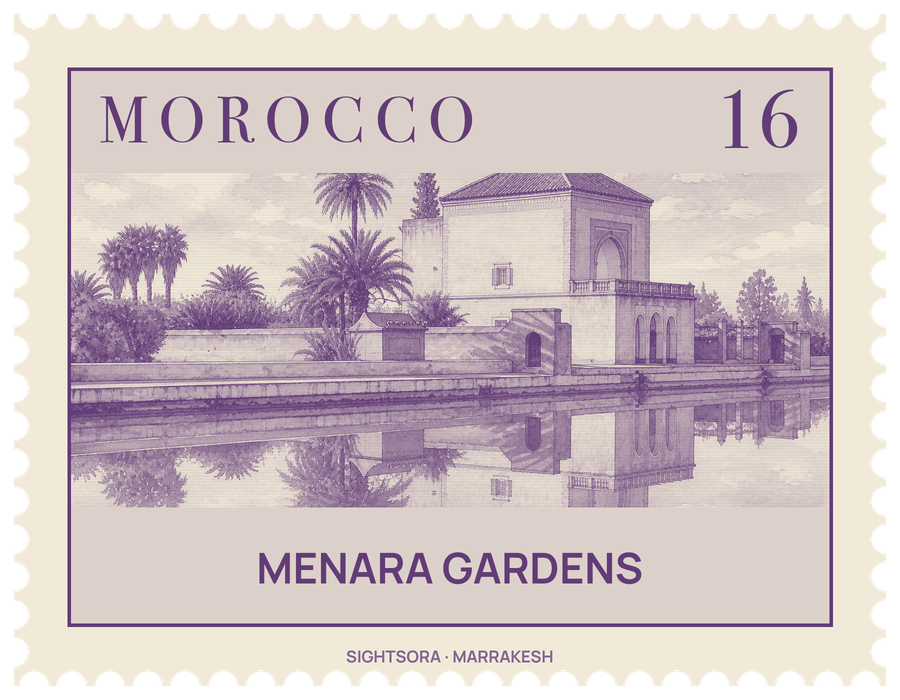
The gardens lie on flat ground west of the old city walls, close to Menara Airport: a reservoir 195 meters long and 160 meters wide, the 19th-century pavilion on its edge and a huge orchard around them. With the Agdal Gardens and the walled medina they have been part of a UNESCO World Heritage Site since 1985.
The Almohad ruler Abd al-Mu'min laid out the estate around 1157, probably to designs by Hajj al-Ya'ish, an engineer from Malaga who also built the mechanical minbar of the Kutubiyya Mosque. Gardens like this were first of all productive farms and only second places of leisure. They fell into decline after the Marinids made Fez their capital, were restored by the Saadians, who first built a pavilion over the water, and owe their present form to the Alaouite sultans Moulay Abd ar-Rahman and his son Muhammad IV, who replanted the orchards and repaired the water supply in the 19th century. Into the early 20th century ostriches were raised here.
The origin of the name is uncertain. Menara can mean minaret, lighthouse or beacon, and it is often linked to the pavilion, but the historian Gaston Deverdun thought it might go back to Almohad times and refer to the Kutubiyya minaret to the northeast, with which the gardens are roughly aligned.
The orchard is still mostly olive trees, with some fruit trees and cypresses, planted in a regular 10-meter grid. Water reached it through khettaras, underground channels dug at a steady slope to tap groundwater in the higher ground towards the High Atlas. The reservoir stands above ground level so that gravity can carry its water out to the trees, and stairs lead up to the walkway around it, with a small octagonal basin, once a fountain, at the foot of the northeast stairs.
The stone pavilion, finished in 1870, has two floors under a pyramidal roof of green tiles and its own small walled garden. A triple-arched portico on the ground floor reaches out over the edge of the water, and above it a balcony opens through a large blind arch painted with arabesques and an inscription giving the completion date. Its decoration is restrained, as in other Alaouite buildings of the period: painted brick-like edges, ochre patterns and carved, painted stucco around the windows, with painted wooden ceilings inside.