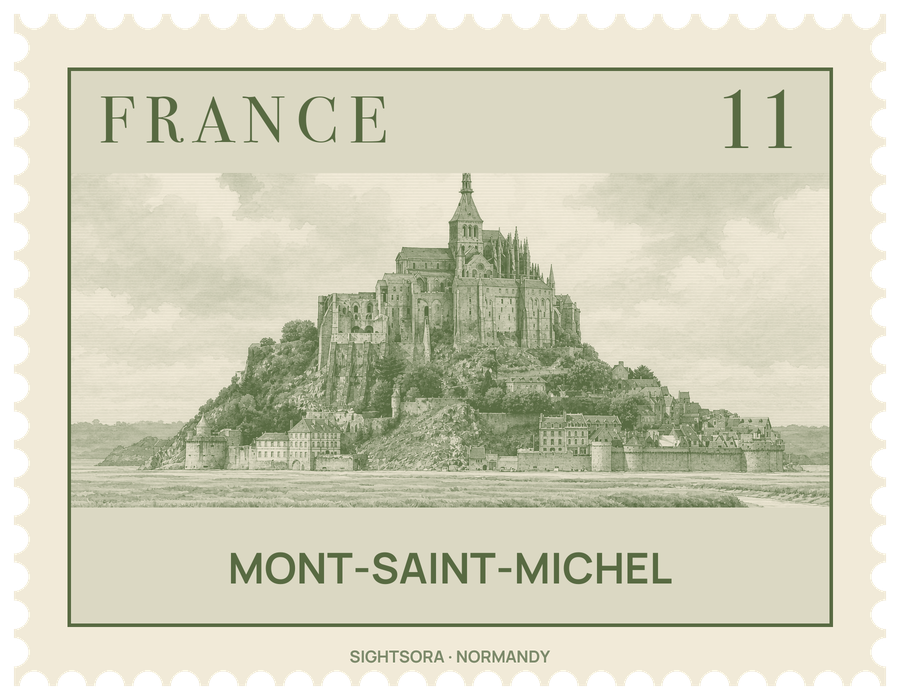
The rock measures roughly 960 m around. Together with its bay, the mount was inscribed on the UNESCO World Heritage list in 1979, and over 60 buildings in the commune are protected as historical monuments.
Before the monks came, the islet was known as Mont Tombe. Legend holds that in 708 the archangel Michael appeared to Aubert, bishop of Avranches, and told him to build a church on the rock. Pilgrims crossed the sands at low tide to reach it, and the same tides made it hard to attack: the mount held out against the English during the Hundred Years' War, and a small garrison beat off a full assault in 1433. Two wrought-iron bombards the English abandoned in 1434 were later recovered by the French. After the Revolution emptied the abbey of its monks, it served as a prison until 1863; a restoration campaign backed by figures such as Victor Hugo led to its listing as a historic monument in 1874, and the architect Édouard Corroyer then spent fifteen years restoring "la Merveille".
The abbey church is the work of several eras. In the 11th century William of Volpiano, chosen by Richard II, Duke of Normandy, set the crossing of the Romanesque church right on the summit, which meant building crypts and chapels underneath to carry the weight; these still form the base of the structure. Robert de Thorigny added the main façade in the 12th century. After Guy of Thouars burned the village in 1204 and the fire spread to the abbey roofs, Philip Augustus paid for rebuilding in the Gothic style. Later abbots and Charles VI strengthened the defences with towers, courtyards and ramparts.
The tides here are large, with a gap of roughly 14 metres between the highest and lowest water. Medieval pilgrims called the place "St. Michael in peril of the sea", and the sands remain dangerous for anyone who leaves the bridge to walk across from the coast. The old causeway was replaced in 2014 by a light bridge designed by Dietmar Feichtinger, part of a project with a dam on the Couesnon meant to clear silt and keep the mount an island. In summer, dolphins sometimes come into the bay and are seen near the small fishing boats known as barquettes.
The island has four museums and a small number of shops, restaurants and hotels inside its walls; salt-marsh lamb, from sheep grazed on the meadows around the bay, appears on local menus. Most visitors come on day trips, so the lanes are at their busiest in the middle of the day in summer, and arriving early or staying into the evening gives a quieter visit. Ten hiking trails let modern pilgrims follow the medieval routes that brought the Miquelots here from Italy, Germany, England and other parts of France.
Getting there
Cars are left in a car park on the mainland about 2.5 kilometres from the island; from there visitors walk or take shuttles across the bridge. Pontorson, the nearest sizeable town, has an SNCF railway station. The closest airport is at Rennes, 88 km to the south.