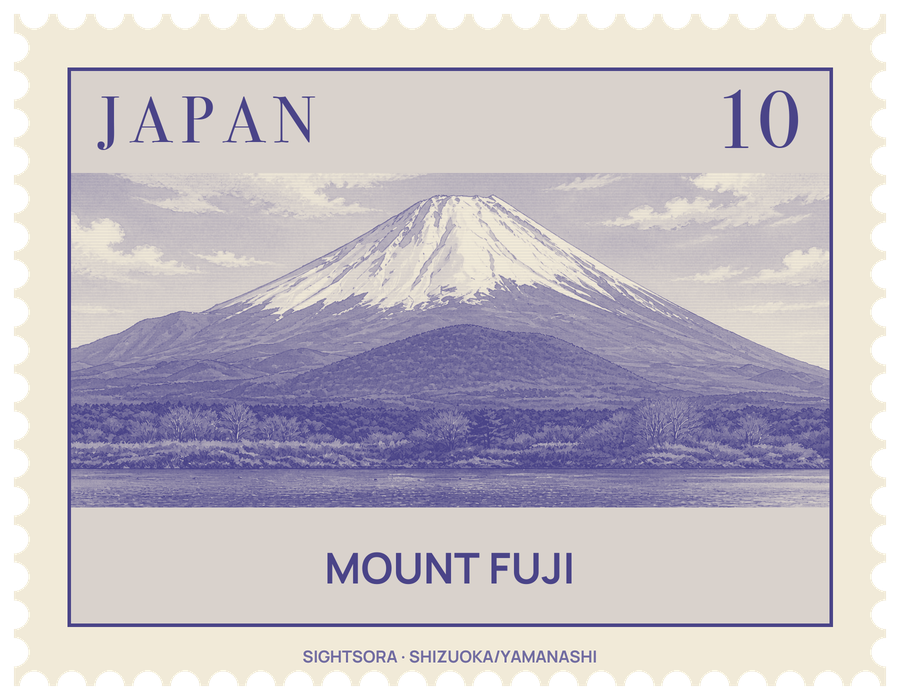
Snow lies on its unusually even, symmetrical slopes for roughly five months of each year. An active stratovolcano, it last erupted in 1707–1708, when the Hōei eruption opened a new crater and a second peak, Mount Hōei, on its southeastern flank. The mountain lies within Fuji-Hakone-Izu National Park and has been a UNESCO World Heritage cultural site since 22 June 2013, together with 25 related places such as the shrine Fujisan Hongū Sengen Taisha.
Fuji has been sacred since ancient times. It counts among Japan's Three Holy Mountains, and Shinto tradition makes Konohanasakuya-hime its goddess. From the Heian period, Shugendō practitioners used it as a base and worshippers began to climb it; in the Edo period the Fuji-kō movement founded by Hasegawa Kakugyō urged its followers to make the ascent. The summit was closed to women until an edict of 1872 lifted the ban. After 1600, when travellers on the Tōkaidō road saw it on their way to Edo, the mountain became a favourite subject of artists, and in the 1830s Hokusai devoted whole print series to it, among them the Thirty-six Views of Mount Fuji.
Four small cities ring the base: Fujiyoshida on the northern side, Gotemba on the eastern, the city of Fuji on the southern and Fujinomiya on the southwestern. Five lakes lie around the mountain, Lake Yamanaka, Lake Kawaguchi, Lake Sai, Lake Shōji and Lake Motosu, and together with Lake Ashi in Kanagawa they are classic viewpoints. Four of them, Kawaguchi, Sai, Shōji and Motosu, belong to the town of Fujikawaguchiko on the northern side, whose tourist office promotes lakeside walks, cycling, lava caves and the Aokigahara forest at the mountain's northwest foot.
Four main routes lead to the summit, clockwise from the north the Yoshida, Subashiri, Gotemba and Fujinomiya routes, each marked by numbered stations; the summit is the tenth. Most climbers start at a fifth station, which can be reached by car or bus, and the climb from there takes five to seven hours, with three to four hours for the descent. The Yoshida route has the most mountain huts and is the one most climbers choose; many come down the Subashiri or Gotemba routes instead, on their loose ash slopes. Many Japanese climbers go up at night to greet the sunrise, the goraikō, from the top. Camping above the fifth station is illegal in the national park.
At the summit, eight peaks ring the main crater, which is 780 m across and 240 m deep, and climbers can visit each of them, including Ken-ga-mine, where the Mount Fuji Radar System once stood. Four older routes also climb from the base of the mountain and pass historic sites; the Yoshida route from the foot is lined with old shrines, teahouses and huts, and Murayama is the oldest route of all.
Getting there
The nearest airport with scheduled international flights is Mt. Fuji Shizuoka Airport, about 80 km from the mountain; Haneda and Narita airports are approximately three hours and 15 minutes away. Climbers reach the fifth stations on the main routes by car or by bus.