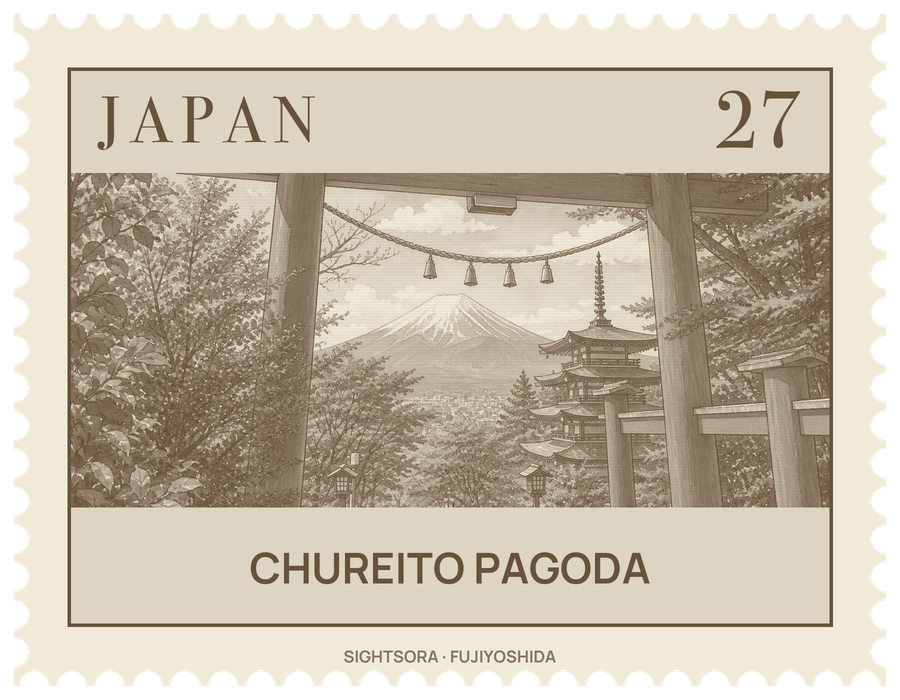
Despite its shape it is not a stupa but a memorial to the war dead: a 19.5-metre tower of reinforced concrete set up in 1962 to enshrine 1,055 people from the city who died in war. A memorial service is held there every September.
The pagoda stands in Arakurayama Sengen Park, laid out in October 1959 over about 4.3 hectares of hillside that also takes in Arakura Fuji Sengen Shrine; the mountain is treated as a sacred area. The park's Sakuya-hime Stairs climb the hill in 398 steps over about 200 metres. The park has about 650 cherry trees of the Prunus × yedoensis variety, and from it there is a wide view over Fujiyoshida city and Mount Fuji. Irises grow about 15 minutes' climb above the pagoda, and an iris festival, the Ayame Matsuri, takes place in the park around June.
The photographs that made the place known were taken from private land next to the park, separated from it by a cliff about 5 metres high. As crowds grew, Fujiyoshida City fenced off that shooting spot in 2015 and stopped visitors from photographing there. The park also has a literary monument to the writer Lee Yangji, who grew up in Fujiyoshida, unveiled in 2016.
Getting there
Shimoyoshida Station on the Fujikyuko Line is a ten-minute walk away, and the Shimoyoshida bus stop is also about ten minutes on foot. By car, the park is about ten minutes from the Fujiyoshida Nishikatsura Smart IC on the Chūō Expressway, and its car park holds 87 cars.