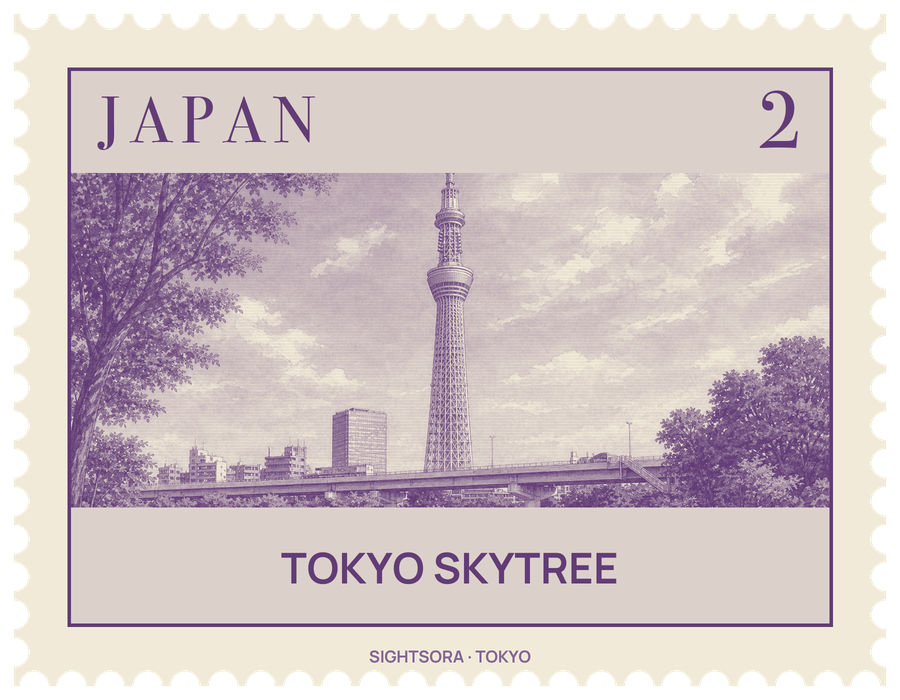
The height was picked to be easy to remember: read in Japanese as 6 (mu), 3 (sa) and 4 (shi), it spells Musashi, the old name of the region the tower stands in. Construction began with a ceremony on 14 July 2008, the tower reached its full height on 18 March 2011, building work finished on 29 February 2012 and the public was admitted from 22 May 2012.
The design, published in 2006, set out to join a neofuturistic form with traditional Japanese beauty, to help revive the surrounding city and to serve disaster prevention. At ground level the steel structure stands on three legs like a tripod, and from about 350 metres up it turns cylindrical. The lattice is painted Skytree White, a colour created for the tower from aijiro, a pale bluish-white from the traditional Japanese palette. At night LEDs light the tower in two schemes that alternate day by day: sky-blue Iki, meaning chic, and purple Miyabi, meaning elegance.
Visitors ride up to two observatories. The lower deck at 350 metres holds up to 2,000 people and looks out over Tokyo through large windows, with a café, shops and a restaurant; a section of glass floor lets visitors look straight down at the streets. The upper deck at 450 metres, the Tembo Galleria, is a glass-walled spiral ramp that climbs the last 5 metres to the highest point of the platform, giving a 360-degree view that changes with the time of day.
Earthquake protection was built into the core. A central shaft of reinforced concrete runs up the middle; it is fixed to the outer frame for the first 125 metres and joined to it by oil dampers from there to 375 metres, which cushion the tower during a quake, and a tuned mass damper moves against the structure's sway. The designers say the system can absorb 50 percent of an earthquake's energy.
The name came from the public: suggestions were gathered in 2007, a committee shortlisted six in March 2008, and "Tokyo Skytree" won a nationwide vote announced on 10 June 2008, ahead of "Tokyo Edo Tower". The tower is the centrepiece of a commercial development owned by Tobu Railway, and the Sumida Aquarium is inside the Tokyo Solamachi complex at its foot.
Getting there
Trains stop at Tokyo Skytree Station, right beside the tower, and at nearby Oshiage Station. The complex lies seven kilometres northeast of Tokyo Station.