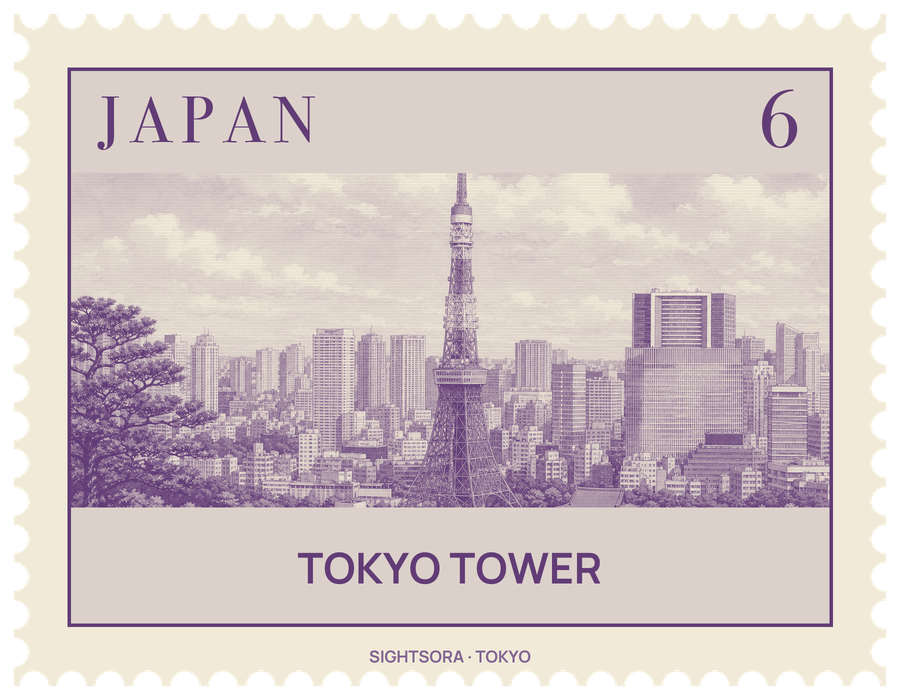
Its official name is Japan Radio Tower, and its design by Tachū Naitō took the Eiffel Tower in Paris as its model, though the Tokyo structure is far lighter, at about 4,000 tons. Since its opening in 1958 it has been a fixed point on the city skyline by day and night, and anime, manga and monster films use it to place a scene in Tokyo, often with Godzilla or Mothra wrecking it.
The tower was built because the spread of television after 1953 threatened to fill Tokyo with transmission masts; one tall tower able to reach the whole Kantō region was the answer, and its height was set by the roughly 150-kilometre range the broadcasters needed. In the postwar boom it was also meant as a symbol of Japan's recovery. Work by the Takenaka Corporation began in June 1957, hundreds of tobi, traditional specialists in high-rise work, joined the crews, and a third of the steel came from scrap of US tanks damaged in the Korean War. Visitors were first admitted on 23 December 1958; radio antennas followed in 1961, and when broadcasting went fully digital, television moved to the taller Tokyo Skytree, leaving FM radio stations on Tokyo Tower.
Visits start in FootTown, the five-story building at the foot of the tower, with shops, restaurants and galleries on the tower's history. Elevators from its first floor rise 150 m to the main deck, which spans two floors and has a café, and a second set of elevators continues from there to a smaller top deck 249.6 m above the ground.
Tower Daijingu, opened on 11 July 1977, is a small Shinto shrine to Amaterasu Omikami inside the tower, its spirit brought from Ise Jingu. It offers seal stamps, votive tablets and charms decorated with the tower; because of its height, its charms are associated with victory and high exam marks, and because couples often propose at the tower, with matchmaking.
After dark the tower is floodlit from 176 lamps set into its frame, a scheme by the lighting designer Motoko Ishii unveiled in 1989. Sodium lamps colour it orange through the cooler part of the year, a warm tone meant to offset winter, and metal halide lamps turn it white in summer. For special occasions the lighting changes, and the windows of the main deck can spell out words or numbers.